
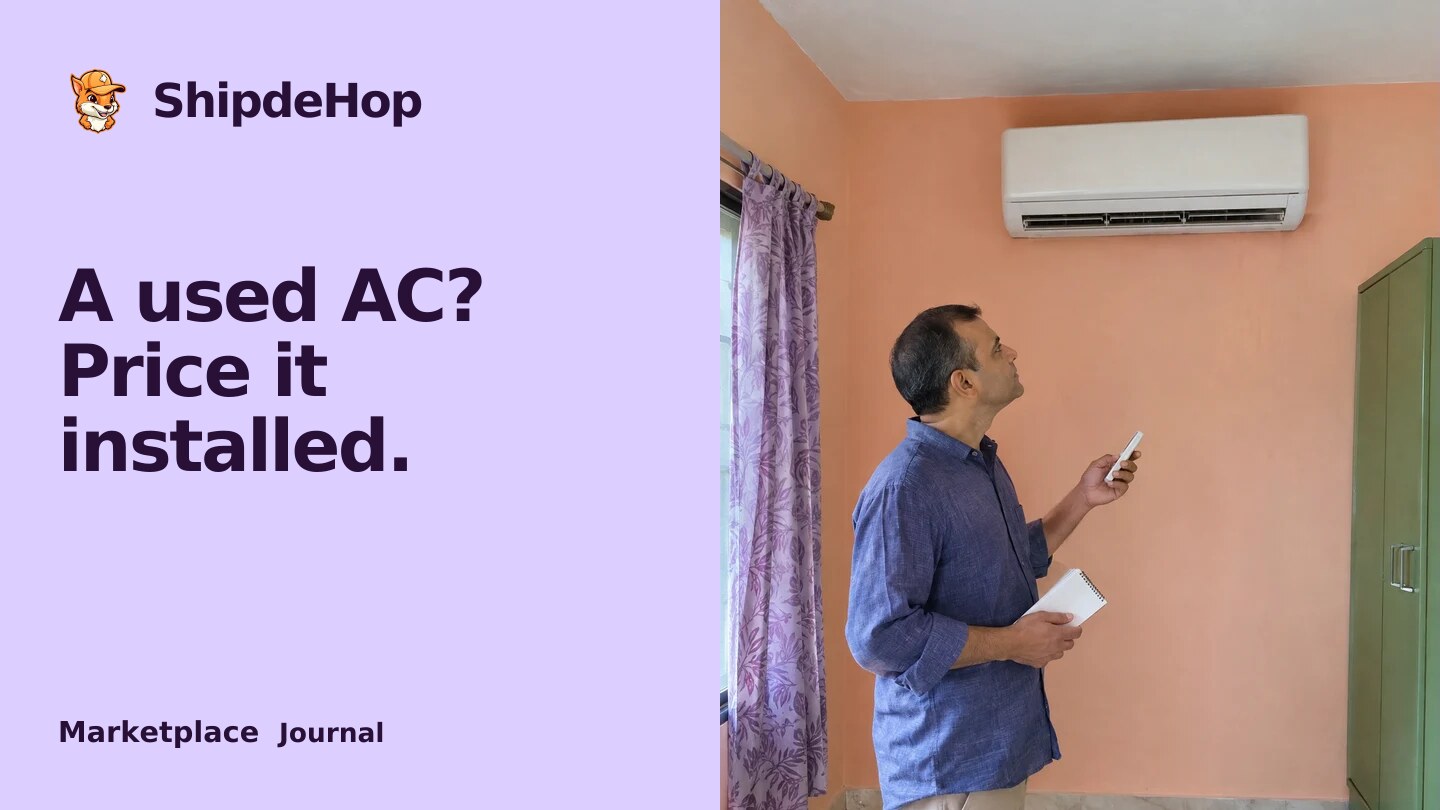
Buy a second-hand split AC only after checking the complete indoor and outdoor system, its suitability for your room and the cost of professional relocation and installation. An installed demonstration provides different evidence from a disconnected unit. Compare the total ready-to-use cost, keep unresolved faults separate from quoted work, and do not treat a star label as proof of present condition.
The attractive price is usually attached to the AC. The job you are buying is a cooled room. Between those two things sit the indoor and outdoor units, professional assessment, removal, transport, installation and a room that can actually accommodate the system.
My first question would be whether the AC is still installed. That answer changes what can be demonstrated before purchase. It does not automatically make one offer good and another bad. It changes the evidence and the uncertainty you need to price.
This guide is for a buyer in India considering a used split air conditioner. Window and portable ACs have different installation requirements, so do not copy the split-system checklist blindly. Manufacturer and government consumer guidance was reopened on 21 November 2026. The decision worksheet is my framework, not an inspection report, a repair tutorial or a promise of savings.
Start with the complete system and its identity
Ask for the exact indoor-unit and outdoor-unit model details, readable photographs of their identification plates, the remote, purchase evidence if available and relevant service records. Keep serial numbers and personal paperwork out of public posts. Have the manufacturer or an appropriate authorised service provider confirm the pairing and model-specific requirements.
Two white boxes with the same brand on them are not enough evidence of compatibility. Do not let a seller's general description replace the actual model identifiers. Ask what is included in the price and what has already been removed, replaced or lost.
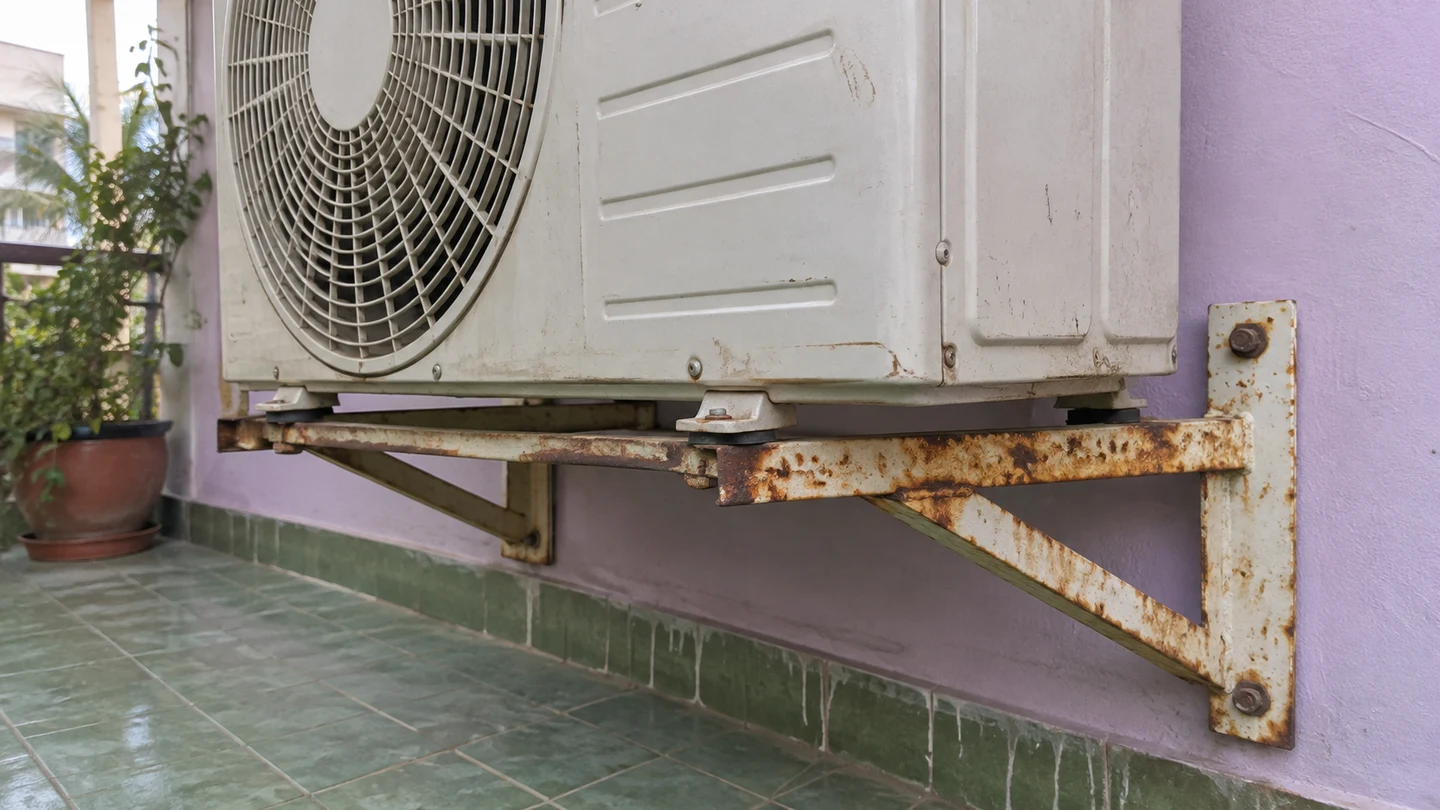
Build an inclusion list before negotiating: indoor unit, outdoor unit, remote and any accessories actually offered. Treat existing pipes, brackets and wiring as items for professional assessment, not automatically reusable value. A photograph can establish that something is present. It cannot establish that it is suitable for your new installation.
An installed AC and a disconnected AC need different evidence
If the seller still has the system installed, ask whether an appropriate professional can assess it in that state before dismantling. A demonstration can show operation at that location at that time. It is not a guarantee about remaining life, every operating condition or performance after relocation.
If the equipment is already disconnected, record that limitation plainly. A video from another room or an earlier date does not establish the condition of the units now in front of you. Ask when and by whom it was removed, how it was stored and which current checks a qualified professional can actually perform.
Use three offer states rather than the vague category 'working AC'. These are purchasing categories, not technical diagnoses. Do not connect disconnected equipment, manipulate refrigerant lines or open electrical enclosures to make an advert easier to evaluate.
| Offer state | Evidence available | Unanswered question | Purchase gate |
|---|---|---|---|
| Installed complete system | Current observations plus an agreed professional assessment | What changes when moved? | Record assessment before authorised removal. |
| Disconnected complete units | Model identity, records, visible condition and feasible professional checks | What cannot be demonstrated now? | Price uncertainty separately and agree assessment terms. |
| Incomplete or unconfirmed pairing | Some components or identifiers only | Can this form a supported usable system? | Resolve compatibility, missing parts and cost before committing. |
| Seller will not allow relevant checks | Only an assertion or old media | What supports the condition claim? | Pause rather than treating unknowns as working condition. |
Check the receiving room before choosing capacity
The Government of India's Ozone Cell consumer FAQ says cooling-capacity selection involves more than room area. It also identifies windows, outside shading, insulation or sealing, occupants and heat from appliances. Use that as a reason to obtain a room-specific assessment rather than a universal square-foot-to-tonnage rule.
Prepare a short site brief: room dimensions, windows and sun exposure, normal occupancy, intended use and the proposed indoor and outdoor locations. Ask the installer what access, drainage, support and electrical arrangements the actual model needs. Do not assume an existing wall hole means the room is ready.
Where you rent, confirm permission for the proposed installation and any alterations before buying. Establish whether an outdoor location can be accessed and maintained appropriately. A system that is inexpensive to collect can be unsuitable for the only location you are allowed to use.
Reference Government of India Ozone Cell: AC capacity factors and energy-label information
Keep relocation and electrical work with qualified professionals
LG's published air-conditioner manual directs customers to an authorised service centre for installation or relocation and says customers should not remove or reinstall the unit themselves. It also calls for qualified help with electrical and grounding questions. Follow the instructions for the actual model you are buying, not a generic internet dismantling sequence.
Ask who will assess, remove, protect, transport, reinstall and commission the system. The same company may handle several steps, but do not assume a transport booking includes technical removal or installation. Obtain a defined scope for each handover.
Keep visible observations separate from professional conclusions. You can record a dent, missing cover, visible corrosion or an undisclosed component. Do not turn those observations into a diagnosis of refrigerant level, compressor health or electrical safety. If an unsafe condition is suspected, stop the demonstration and seek appropriate professional help.
Ask the service provider to identify model-specific installation needs and which existing materials, if any, can be reused. Do not budget a routine refill or assume a refill will cure weak cooling. First establish what has actually been assessed and what work is justified.
Reference LG official air-conditioner manual: authorised relocation and qualified electrical work
Calculate the ready-to-use cost in INR
Start a ledger with the seller price, then add the work needed to reach a usable installation in your room. Request quotes against the same models, addresses, access conditions and scope. A quote for installation alone is not a quote for buying, removing and moving a used system.
Use the table below without entering zero for an unanswered item. Mark each amount as included, separately quoted or unresolved. Check that a charge has not appeared twice under different names, especially where one service provider supplies a package.
Keep known repair work separate from an optional reserve for problems that have not been diagnosed. A reserve is your budget decision, not a repair estimate. If a material fault cannot be assessed or priced, say so. The discount is not automatically big enough just because the asking price is lower than a new model's price.
| Cost line | What the quote should identify | Common omission |
|---|---|---|
| Purchase | Exact units, remote and included items | Assuming every pictured accessory is included |
| Assessment and removal | Scope, location, access and responsibility | Treating dismantling as ordinary loading |
| Protection and transport | Both units, packing, access and carrying | Quoting only one small indoor unit |
| Receiving-site work | Required support, drainage and electrical assessment or work | Assuming the room is already installation-ready |
| Installation and commissioning | Model-specific scope and excluded materials | Calling an incomplete estimate a final total |
| Confirmed repair | Actual assessed work and supported quote | Treating an unresolved fault as a small fixed expense |
Read the energy label without promising an electricity bill
The Ozone Cell FAQ describes an AC energy label as an efficiency indicator containing model, capacity and label-period information. Record the actual label and its period rather than repeating only the star count from an advert. The same FAQ cautions that the label does not itself choose the best appliance for the buyer.
For a used system, that label is not a current condition report. Ask about service history and obtain the professional assessment appropriate to the model. Do not multiply a remembered wattage by an assumed daily runtime and call the result your future bill.
If running cost is important, compare suitable systems using documented model information and a consistent, explicitly stated usage assumption. Treat the result as a planning estimate. Your room, weather, use and the equipment's present condition are still relevant. This article does not promise a particular saving from buying used.
Reference Government of India Ozone Cell: AC capacity factors and energy-label information
Agree two handovers and a clear stop point
The first handover is at the seller's property. Record the unit identities, what was assessed, what is included and who is authorised to remove the equipment. The second is after professional installation at the receiving property, when the agreed commissioning scope can be completed. Collection alone does not settle both stages.
Before paying or arranging removal, agree the commercial terms if the equipment differs from its description or an assessment reveals work outside the accepted scope. Get those terms directly from the seller. Do not assume a private sale includes the return rights, warranty or installation support of a retailer.
The broader inspection-before-collection guide explains why a collector is not automatically a product expert. For an AC, that boundary matters: somebody transporting the units is not necessarily qualified to assess or install them.
- Both model identifiers and system compatibility have been checked.
- The offer is labelled installed, disconnected or incomplete, with limitations recorded.
- The receiving room and proposed installation location have been assessed appropriately.
- Professional removal, transport and installation responsibilities are assigned.
- The ready-to-use budget includes confirmed work and separately flags unknowns.
- Seller terms and the commissioning scope are understood before the move.
Where ShipdeHop helps with the purchase decision
ShipdeHop is India's people-powered super app for shared journeys, parcels and peer-to-peer exchanges. Explore Marketplace planning to prepare a pre-loved purchase, but do not treat a platform identity check as an appliance assessment. An AC transaction still needs an appropriate seller agreement and qualified technical work.
Read current app availability before making plans. The website's local planning tools do not provide live listings, matching, bookings or payments. ShipdeHop takes zero platform commission, now and always, but that does not remove purchase, technical service or transport costs. It offers no in-app payment or escrow, and Aadhaar identity verification does not inspect equipment or guarantee conduct.
My decision rule is simple: buy the system you can identify, assess and afford to make usable in the right room. If the deal only works while removal, installation or an unknown fault is left out, the price has not answered the question yet.
Reference ShipdeHop current availability: planning, identity and payment limitations
What does the complete purchase cost?
Change the amounts to match your proposed arrangement. Include every relevant expense.
Questions, answered
Is it worth buying a second-hand split AC in India?
It can be worth considering when the complete system, room suitability, condition evidence and ready-to-use cost are understood. Compare assessed installation and repair needs with a suitable alternative. A low asking price by itself does not establish value.
Can I assess a disconnected AC by switching on the indoor unit?
Do not improvise electrical connections or a test installation. An indoor unit alone cannot demonstrate the complete split system's cooling performance. Ask an appropriate authorised service provider what can be assessed in its current state and what must wait for proper installation.
Does a five-star label prove a used AC is in good condition?
No. An energy label is not a current condition report. Record the model and label period, then separately establish the equipment's present state and suitability for the receiving room.
Should I budget for gas refilling when buying a used AC?
Do not assume a routine refill is necessary or that it solves an unknown cooling problem. Have a qualified service provider assess the actual model and condition, then quote justified work. Keep unresolved faults separate from confirmed repair costs.
Does ShipdeHop inspect or install the AC for me?
No technical assessment or installation should be inferred from Marketplace planning or identity verification. Arrange appropriate qualified professional help, verify current app capabilities and agree the purchase and service scope directly.
Sources and useful references
External source pages checked on 21 November 2026. The worked amounts are inputs for the decisions explained above.
- LG official air-conditioner manual: authorised relocation and qualified electrical workChecked 21 November 2026
- Government of India Ozone Cell: AC capacity factors and energy-label informationChecked 21 November 2026
- ShipdeHop current availability: planning, identity and payment limitationsChecked 21 November 2026

I’m building ShipdeHop around useful connections between people, journeys and pre-loved things. Zero commission. Now and always.
Why I’m building ShipdeHop →