
Buy a second-hand camera in India only after pricing the complete setup you need and checking the actual body-and-lens combination. A body-only offer makes sense when your existing lens and charging equipment are confirmed compatible. Otherwise compare a tested kit, including power, storage and file transfer. Unverified essentials are reasons to pause, not assumed savings.
I would start a used-camera shortlist with one question: what must be in your hands before you can make the photographs you actually want? Not which listing has the biggest discount badge. A camera body without a usable lens, power and a way to retrieve its files is an unfinished purchase.
This guide is for an Indian buyer choosing between a DSLR or mirrorless body and a bundle with a lens. The useful comparison is ready-to-shoot cost plus unresolved checks. I am not ranking models, inspecting a particular listing or promising that a clean-looking camera has years of life left.
Define the first shoot before choosing the camera body
Write down one real job. Perhaps you want to photograph products in a Bengaluru home studio, record short cooking videos in Pune or take family photographs on a visit home. Those jobs ask different things of a kit. A lens that works for one may not give you the framing or handling you want for another.
Turn the job into a small demonstration request: still photo or video, near or distant subject, the lens you intend to use, and the device on which you need to open the file. Ask whether that demonstration is possible before travelling to meet the seller. A still photograph does not demonstrate the video workflow you need.
If you already own a lens, bring its full model name into the shortlist. If you own nothing, compare complete usable configurations from the beginning. Do not let a body-only price set a budget that quietly excludes half the equipment.
Match exact body, lens and adapter identities
Record the body model, complete lens model and any adapter model separately. A brand name is not a compatibility check. Ask for current photographs of their identifying markings and compare the actual items when inspecting. A listing description can omit the suffix that distinguishes one version from another.
Canon India's support page for the original EOS R gives a concrete example: RF lenses are supported, EF and EF-S lenses require a mount adapter, and EF-M lenses are not supported. That is guidance for that named camera, not permission to generalise across every Canon body. Reopened on 22 November 2026, the page also illustrates why a familiar brand name is insufficient.
Sony's official lens compatibility tool lets you select a body, lens and mount adapter. Its ILCE-6400 results distinguish full compatibility from compatibility with restrictions. Look up your exact combination and read the details, including any applicable firmware notes, before counting an existing lens as a zero-cost part of the purchase.
My rule is simple: a lens being supplied in the same bag does not establish that it does the job. If the required combination cannot be demonstrated, write 'not verified'. Do not convert that into 'probably fine'.
Reference Canon India: original EOS R compatible lenses, batteries and charging accessories · Sony: ILCE-6400 lens and mount-adapter compatibility information
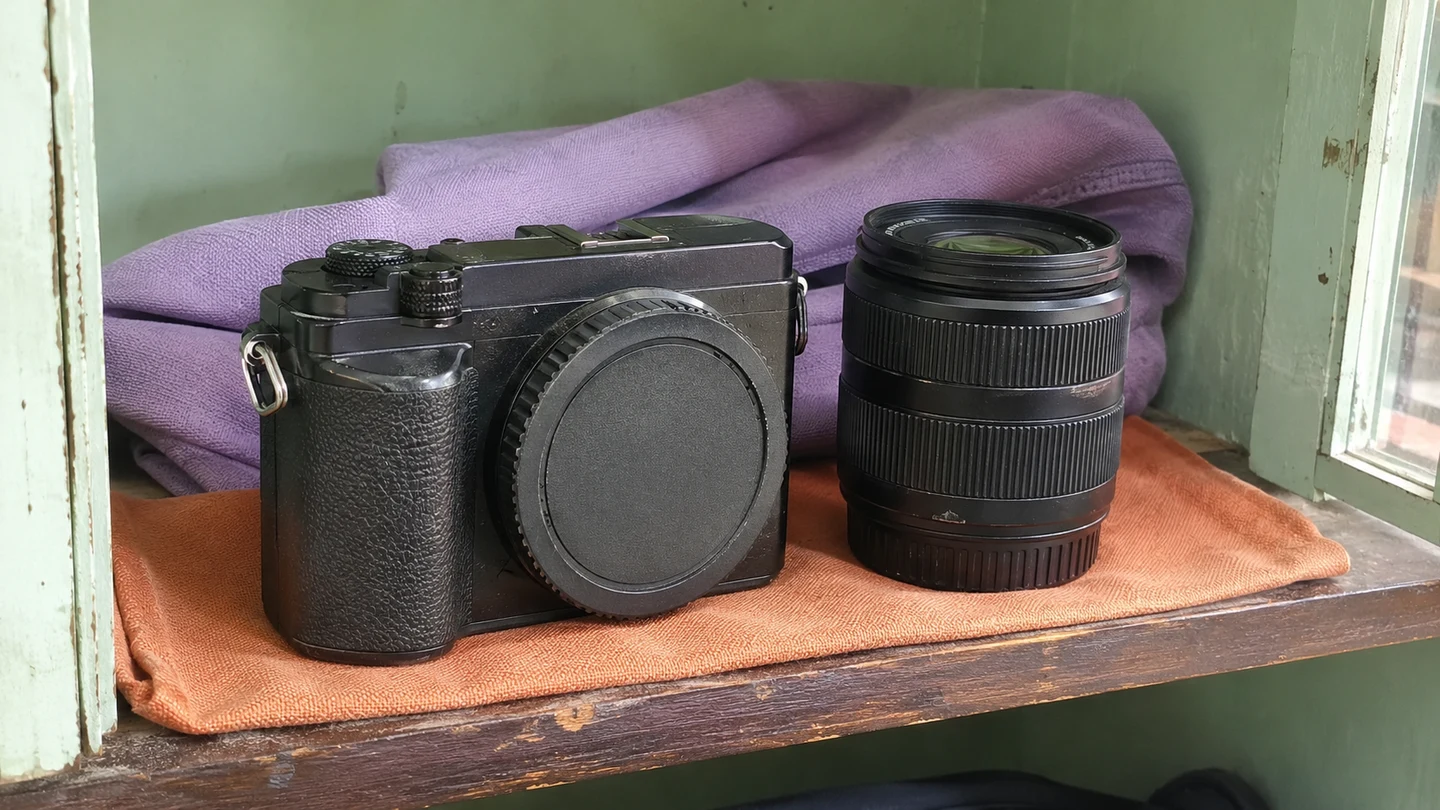
Body-only or kit: use a readiness decision table
This is a purchase decision table, not a laboratory certification. Apply it to the exact items being offered. 'Kit' means the seller's stated bundle here, not a promise that every necessary accessory is included.
Separate a documented limitation you can live with from an unknown that prevents your intended use. The former can be priced. The latter needs an answer before a bargain becomes meaningful.
| Offer or finding | Evidence needed | Decision before paying |
|---|---|---|
| Body only, and you own a lens | Exact combination checked in official guidance and demonstrated with your lens | Compare body cost plus any missing power, storage and transfer equipment |
| Body plus an included lens | Both exact models, the actual lens condition and a capture-to-file demonstration | Compare the complete bundle, not the body's implied share of the price |
| Adapter needed | Exact adapter, applicable restrictions and intended functions demonstrated | Include adapter cost and reject assumptions about untested functions |
| Camera starts, but no saved file is shown | A fresh capture saved, reviewed and opened on your intended device | Pause. Powering on is not proof of a working capture workflow |
| Missing charger or uncertain battery combination | Model-specific charging guidance and a suitable demonstrated setup | Price the verified replacement or leave the offer unresolved |
| A feature essential to your job cannot be tested | An agreed independent assessment or another test opportunity | Do not buy on the assumption that a lower price removes the uncertainty |
Demonstrate capture, playback and a usable file
Agree a short, non-destructive check using the manufacturer's instructions. Start with the assembled body and lens you plan to buy, not a different lens from the seller's cupboard. Ask the seller to show normal controls, focus operation and a fresh capture. Review the result on the camera, then open the saved file on the device you intend to use.
Use a non-personal subject and storage equipment everyone has agreed to use. Do not format the seller's card or browse their private photographs. If a required test would change settings or data, ask first. Keep the scope proportionate and avoid treating a meeting as permission to experiment with someone else's equipment.
For video, agree the intended recording mode and a representative clip, then check the saved picture and sound relevant to your use. A brief demonstration is still only a brief demonstration. It does not establish long-session reliability, every recording mode or future battery endurance.
Record an observation precisely: 'this file opened on this laptop' is useful. 'Everything works' is too large a conclusion. If there are unexplained marks in output, intermittent errors, loose connections or other concerns you cannot assess, ask a qualified camera service provider rather than attempting a repair at the meeting.
- Confirm the actual body, lens and adapter match the agreed model record.
- Ask about known faults, liquid exposure, repairs and service records without treating an answer as independent proof.
- Inspect visible casing, controls, screen, lens glass and accessory condition without opening the equipment or touching a sensor.
- Demonstrate the specific focus, capture, playback and file-opening steps required for your intended use.
- List which functions were not checked, who can assess them and whether that affects your decision.
- Stop if the actual bundle or condition differs materially from what you agreed to inspect.
Verify the battery and charger as a combination
A charged camera at the meeting does not show how you will recharge it tomorrow. Record the battery, charger and any required power-adapter models. Check the exact camera documentation rather than assuming that a familiar-looking connector or a battery that powers the body establishes charging compatibility.
Canon's original EOS R support page provides a useful, narrowly scoped example. It permits LP-E6 as well as LP-E6N for power, but says charging with the PD-E1 USB power adapter is available for LP-E6N, not LP-E6. Do not apply that example to other models. Use it as a reminder to check the whole combination.
Ask for the stated charging route to be demonstrated appropriately. Do not open batteries, use damaged charging equipment or improvise a power setup. If a safe, correct demonstration is unavailable, budget only from a verified replacement option and keep the unresolved condition visible. A spare battery is an included object, not a guaranteed number of shooting hours.
Reference Canon India: original EOS R compatible lenses, batteries and charging accessories
Price a ready-to-shoot setup, not an attractive body
Use a worksheet with two columns: body-only offer and complete-kit offer. For each, enter the agreed item price in INR, required lens, any required adapter, usable battery and charging equipment, compatible storage, file-transfer equipment, an assessment if needed, and collection or packing costs. Mark included usable items as included so you do not buy or count them twice.
Treat a replacement cost as confirmed only after checking the exact part and a current quote. If a seller says a charger is easy to find, that is a task for your worksheet, not a zero. Keep unknown repair costs in an unresolved row instead of inventing an average repair allowance that makes the total look complete.
Ready-to-shoot total equals the agreed bundle price plus missing essentials, agreed assessment costs and collection costs. Keep optional upgrades outside that total. Your future portrait lens and a bag you fancy should not hide whether today's setup is usable.
The body-only offer can be the sensible choice when you already have confirmed compatible essentials. A complete kit can be sensible when it demonstrably meets your job without extra purchases. Neither wins automatically. Compare the same intended output, not one stripped-down body against another seller's fully equipped bundle.
Use the marketplace complete-cost calculator within ShipdeHop's calculators to organise your own amounts. It is a planning aid, not a live camera valuation, a replacement-parts quote or a promise of savings.
Keep purchase approval separate from camera collection
If someone else collects the camera, send a bounded written brief: exact body, lens and adapter, the included battery and charging equipment, agreed price, known faults, approved checks and the conditions that mean 'do not collect'. Tell the seller who is authorised to receive it. A photograph of a sealed bag does not establish what was demonstrated before packing.
Do not appoint a traveller as a camera technician by accident. An agreed collector may be able to match visible models and count accessories but not assess lens condition or diagnose a fault. Decide who gives purchase approval before anyone takes possession. Use the item inspection guide to separate checking the purchase from moving it.
After approval, agree how the camera and lens will be protected and who is responsible for the handoff record. Any transport arrangement needs its own acceptance, packing and battery checks. A camera being small does not make it automatically suitable for every journey.
Use ShipdeHop with the current product limits in view
Explore ShipdeHop Marketplace when planning a pre-loved purchase in India, then check the current app and the actual arrangement. The website's planning pages do not establish a live camera listing, a confirmed collector or a booking. I would rather make that boundary clear than let a convenient-looking page do the promising.
As checked on 22 November 2026, ShipdeHop's availability page links to the iPhone app, says a public Android Play listing has not been verified, and states that website plans do not create app bookings. ShipdeHop takes zero platform commission, now and always, but does not collect in-app payments or offer live escrow. Zero commission does not remove equipment, inspection or collection costs.
Aadhaar identity verification is not a camera inspection, a warranty or a guarantee of another person's behaviour. Keep the item decision grounded in actual evidence. My final test would be: can this exact bundle produce the output I need, can I open it, and have I priced everything required to repeat that at home? If not, the purchase is still incomplete.
Reference ShipdeHop: current India scope, app availability and payment limitations
What does the complete purchase cost?
Change the amounts to match your proposed arrangement. Include every relevant expense.
Questions, answered
Is a second-hand camera body-only deal better than a kit?
Only when the body works with the lens and other essentials you already own, or when the verified cost of missing equipment still makes the offer suitable. Compare both offers as ready-to-shoot setups for the same job. An included lens that does not meet that job is not automatically useful value.
Can I use my old DSLR lens on a used mirrorless camera?
Do not decide from the brand name alone. Record the exact body, lens and adapter models, consult the manufacturer's compatibility guidance and demonstrate the functions you need. Some named combinations require an adapter or have restrictions. Compatibility for one camera does not establish compatibility for another.
Does a low shutter count prove that a used camera is healthy?
No. Even a reported count supported by an appropriate reading is not a health certificate or a promise of remaining life. Keep it as one piece of information alongside condition, repair history, observed operation and sample output. Do not let a single number replace assessment of an unexplained fault.
What should come with a second-hand camera?
There is no universal bundle. Agree the exact body, any lens or adapter, battery, charging equipment, caps and any storage or transfer accessories included. Check each against your intended setup. A listing called 'camera kit' can still leave you needing an essential item.
Should I pay before someone collects the camera for me?
First settle who checks the actual equipment, who approves the purchase, what the payment arrangement is and what happens if the item differs. Collection alone is not technical inspection. ShipdeHop does not provide live escrow, so do not assume an app connection creates payment protection or a return right.
Sources and useful references
External source pages checked on 22 November 2026. The worked amounts are inputs for the decisions explained above.
- Canon India: original EOS R compatible lenses, batteries and charging accessoriesChecked 22 November 2026
- Sony: ILCE-6400 lens and mount-adapter compatibility informationChecked 22 November 2026
- ShipdeHop: current India scope, app availability and payment limitationsChecked 22 November 2026

I’m building ShipdeHop around useful connections between people, journeys and pre-loved things. Zero commission. Now and always.
Why I’m building ShipdeHop →