

A second-hand fridge is worth considering when its actual condition, usable space, moving plan and complete cost fit your needs. Check the exact model and ask for a credible cooling demonstration before committing. Add inspection, transport, missing parts and installation to the price, then consider electricity separately. Do not treat an illuminated interior or a cheap listing as proof of reliable cooling.
A fridge is very good at looking like a finished purchase. It stands there, the light comes on and the seller says it cools perfectly. The asking price has already started doing persuasive work.
I would separate the decision into evidence and arithmetic. First establish what this particular appliance can do and what comes with it. Then work out what buying, moving and using it will require. A low seller price cannot answer either question by itself.
This guide is for a household buyer considering a used domestic refrigerator in India, not a commercial cold-storage purchase. Official manufacturer guidance was reopened on 13 November 2026. The buying framework and hypothetical calculations below are planning tools, not a product test or a promise about remaining life.
Identify the actual fridge before comparing prices
Ask for the exact model, approximate age, current photographs, known faults, service history and the reason for sale. Ask whether the invoice and manual are available. Match the identifier on the appliance to the information provided. Similar-looking doors can hide different capacities and replacement parts.
Decide what you need to store. Check usable shelves, freezer arrangement, bottle space and whether your normal containers fit. A larger headline litre figure is not automatically a better arrangement for your kitchen or household.
Separate direct-cool and frost-free models in your comparison and obtain the correct care instructions. Do not assume the maintenance routine, clearance or restart guidance from another fridge applies. Manufacturer support or an authorised technician can help resolve model-specific questions.
Use the pre-loved inspection guide to structure the enquiry, but add the refrigerator-specific evidence below. A friendly seller or identity check does not establish cooling performance.
A light inside is not a cooling demonstration
Ask the seller to arrange a suitable working demonstration before you decide. Establish how long the appliance has been running, which settings are being used and what can actually be observed. A video of the light switching on shows the light, which is a considerably smaller achievement than refrigerating food.
If cooling performance is uncertain, obtain an assessment from a qualified appliance technician. Do not diagnose compressor health, refrigerant condition or remaining lifespan from one sound, a cold hand against a shelf or a seller's assurance that it only needs gas.
Record what was observed and what was not. A demonstration can reduce uncertainty without proving future reliability. Ask about return arrangements or any written warranty from a dealer, and verify the scope rather than treating a private-sale conversation as a warranty.
Do not open electrical panels, interfere with refrigerant lines or power a visibly unsafe appliance to complete a checklist. A damaged cable, suspected leak or unexplained electrical problem is a reason to stop and seek qualified advice.
Include every shelf, drawer and known fault in the price
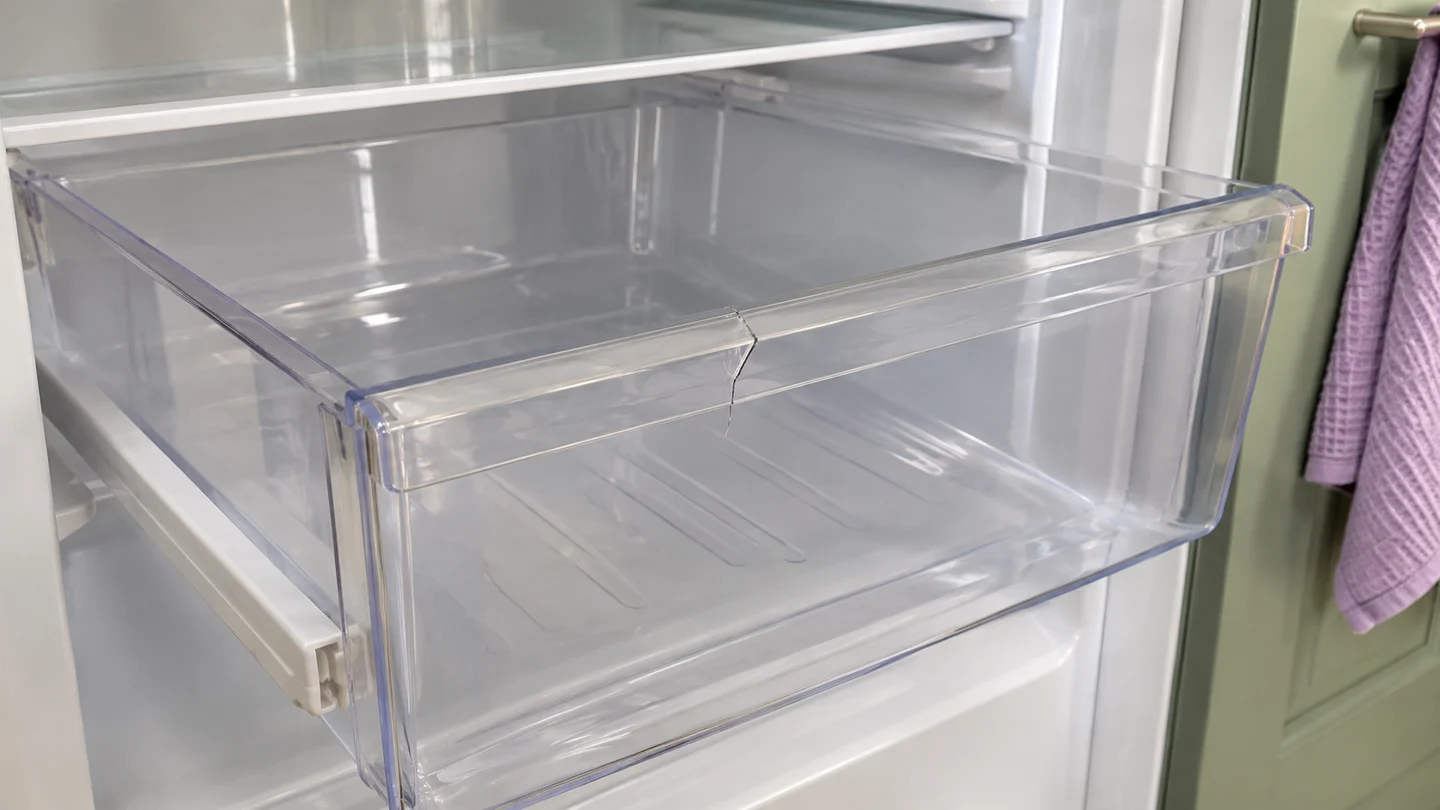
Check the supplied shelves, bins, drawers, handles and any model-specific fittings against the agreed list. Look for visible cracks or missing supports without dismantling the appliance. An empty space where a drawer should be is not an extra feature.
A small plastic part can matter to daily use. Before accepting a missing or damaged component, ask an authorised parts or service channel whether the exact replacement is available and what it will cost. Do not budget for a generic part because it looks approximately the right shape.
Photograph agreed damage and list what the seller will supply. Keep this record private and share it with the people handling the purchase. At collection, pause if the appliance or included parts differ. The person arriving with a vehicle should not silently accept a changed purchase for you.
Check the kitchen space as an operating location
Samsung India's refrigerator installation guidance calls for a location out of direct sunlight, suitable level flooring and room for doors to open. It also notes that inadequate space can affect cooling and that access is needed for maintenance. Use this as a reminder to check the destination, not a universal dimension for every model.
Measure the appliance and the space it will occupy, including door movement and the clearances specified in its manual. Also check the route through doors, lift and turns. A fridge that fits the floor rectangle may still fail when you need to open the door fully enough to remove a drawer.
Have a qualified installer confirm any power, water-connection or site work your model requires. Obtain permission for changes in a rented home. Do not improvise electrical connections to rescue a purchase that does not fit the location.
The best moment to discover an unsuitable kitchen corner is before paying someone to carry a fridge to it.
Reference Samsung India official refrigerator location, door clearance and installation guidance
Price a move that respects the appliance
LG India's moving guidance advises keeping a refrigerator upright and securing it upright for vehicle transport. It explains that tilting or moving on its side can affect the compressor oil and other components. Give the mover the model, dimensions, collection and delivery access before asking for a quote.
Ask who prepares the appliance, protects it, carries it at both ends and places it in its final position. Describe stairs, lift restrictions and the permitted parking point. A vehicle fare does not necessarily include all that handling.
Confirm the restart instructions for the exact model and the way it was transported. LG's cited general guidance, for example, gives a waiting instruction after side transport and distinguishes that from upright movement. Do not turn one manufacturer's example into a fixed waiting time for every fridge.
Arrange for the seller to remove food and prepare the appliance in accordance with its instructions. Resolve any defrosting, water connection or technical preparation with the responsible service person. The moving photograph here is illustrative, not a certified method or permission to handle a heavy appliance alone.
Reference LG India official refrigerator upright transport and model-dependent moving guidance
Keep purchase cost and electricity assumptions separate
First total the money required to acquire an acceptable, usable fridge at home. Use confirmed amounts in INR. Mark a line included only when that scope is confirmed, and do not add it again elsewhere. Keep significant unresolved faults outside the total as a decision blocker, not a hopeful ₹0.
Then make a separate running-cost comparison. If reliable model information gives annual electricity use in kWh, multiply that input by an appropriate per-kWh rate from your actual bill or tariff. Note the source and period. Do not infer a used appliance's present consumption from its appearance.
For an arithmetic example only, suppose one comparison input is 180 kWh a year and another is 300 kWh. At an assumed ₹8 per kWh, the simple annual energy amounts are ₹1,440 and ₹2,400, a difference of ₹960. These are invented worksheet inputs, not measured fridges, current tariffs or a savings forecast.
Actual use can differ with condition, settings, household use and installation. Fixed charges and tariff structure can also make a simple multiplication different from the change in your bill. If the consumption information is missing or unreliable, record the uncertainty instead of manufacturing a precise first-year total.
The marketplace cost calculator can organise the upfront purchase inputs. Keep the running-cost notes alongside it because the calculator is not an appliance energy audit.
| Cost or evidence line | What to enter | How to handle uncertainty |
|---|---|---|
| Agreed seller price | Actual INR | Use the same appliance and included parts |
| Inspection or assessment | Quote or confirmed included | Do not replace diagnosis with a repair guess |
| Packing, handling and vehicle | Complete written scope and INR | Both addresses and floors must be described |
| Known replacement parts | Exact-model quoted INR | Check availability before buying |
| Installation or authorised site work | Actual quote if needed | Confirm destination requirements |
| Upfront purchase total | Sum confirmed required costs | Hold if an essential task remains unpriced |
| Annual electricity input | Source kWh/year and chosen INR/kWh | Scenario, not measured performance |
| First-year comparison | Upfront total plus stated scenario | Keep assumptions and unknowns visible |
Send an evidence card before making an irreversible commitment
Use a short record rather than a long reassuring chat. Ask the seller to confirm the points below and attach current photographs. If a dealer supplies a warranty or return policy, retain the actual terms with the receipt.
Compare the resulting purchase with a real alternative available to you, including delivery, installation and any supported return or warranty terms. A bare private-sale price and an installed retail price are not like-for-like figures.
My stopping rule is a maximum upfront spend plus a maximum unresolved issue. If the purchase only works when cooling, repairs, parts or moving costs are assumed away, choose another listing. A discount does not make uncertainty disappear.
- Exact model, approximate age and available invoice or service history.
- Current condition, declared faults and photographs of damage.
- Working demonstration agreed, with observed and untested points recorded.
- Included shelves, drawers, bins, handles and other fittings.
- Inspection and exact-model replacement quotes where required.
- Collection access, preparation, mover scope and final placement.
- Manual-specific installation and post-transport restart plan.
- Agreed price, receipt, return arrangements and any written warranty.
Where ShipdeHop fits, and where appliance specialists are needed
Start with the ShipdeHop marketplace for the pre-loved buying and selling context. This guide does not establish a current fridge listing, a matching transporter or a technician. A refrigerator is a heavy appliance, not something to squeeze into a traveller's spare luggage allowance.
Use appropriate appliance transport and qualified service where needed. A collector can confirm that the described item and parts are present, but should not be expected to diagnose its cooling system merely because they arrived first.
ShipdeHop takes zero commission, now and always. That does not remove purchase, inspection, handling, repair or electricity costs. Check current product availability before relying on any channel. The website's India-only plans do not create live matching or bookings, and production payments and escrow are disabled.
My verdict is not that used fridges are good or bad. Buy one when the actual evidence and the complete plan make sense. The strongest bargain is the one that still looks sensible after it is home and running. All accompanying images are generated editorial illustrations, not tested appliances, customers or completed moves.
Reference ShipdeHop official current product availability and website planning limitations
What does the complete purchase cost?
Change the amounts to match your proposed arrangement. Include every relevant expense.
Questions, answered
How do I check a second-hand fridge before buying?
Identify the exact model, inspect the actual appliance and included parts, ask for a suitable working demonstration and record known faults. Use a qualified technician when cooling or safety is uncertain. A light coming on does not demonstrate adequate refrigeration or remaining lifespan.
Can I transport a used refrigerator lying down?
Plan the move around the exact model's manufacturer instructions. LG India's general guidance advises upright movement and securing the fridge upright for vehicle transport. Do not decide on side transport merely because it fits a cheaper vehicle. Discuss access and handling with an appropriate mover.
How long should I wait before switching on a moved fridge?
Use the exact model's instructions and tell the service provider how it was transported. Waiting requirements can depend on the appliance and its position during the move. Do not apply one fixed time taken from another model's guide.
Is an old fridge's energy label a guarantee of my electricity bill?
No. If reliable annual consumption information is available, it can be an input to a clearly labelled comparison. It is not a measurement of the used appliance's present condition or your household's actual use. Keep the rate, assumptions and any missing information visible.
What should I include beyond the seller's fridge price?
Consider inspection, preparation, protection, carrying at both addresses, transport, known parts and installation work where required. Compare electricity separately using stated assumptions. Do not count included costs twice or enter an unresolved repair as zero.
Sources and useful references
External source pages checked on 13 November 2026. The worked amounts are inputs for the decisions explained above.
- LG India official refrigerator upright transport and model-dependent moving guidanceChecked 13 November 2026
- Samsung India official refrigerator location, door clearance and installation guidanceChecked 13 November 2026
- ShipdeHop official current product availability and website planning limitationsChecked 13 November 2026

I’m building ShipdeHop around useful connections between people, journeys and pre-loved things. Zero commission. Now and always.
Why I’m building ShipdeHop →