
To send documents by courier within India, first confirm whether the recipient needs originals and what counts as accepted delivery. Then check the exact document type, serviceable PIN codes, booking cut-off, packing and proof-of-delivery terms. Compare the complete cost, not just postage. Tracking an envelope to an address does not by itself confirm that an office accepted the paperwork inside.
A document envelope may weigh very little and still carry a large unfinished job. It could contain the certificate someone needs for an application, signed papers for an office or records that are awkward to replace. The postage is not always the most important number.
I would begin with the recipient, not the courier search box. Ask what they actually need, where it must arrive and what evidence will close the task. Only then choose how to move the envelope.
This guide is for domestic journeys within India. It does not establish whether a particular institution accepts a copy, whether a document may be carried under every service's rules or whether a deadline can be met today. Those details need explicit confirmation.
First decide whether the original needs to travel
Ask the receiving person or office whether they require the original, a particular type of certified copy, an ordinary copy or an electronic submission. Obtain the answer through the institution's official instructions or contact channel. Do not assume a scanned copy is acceptable, but do not dispatch an irreplaceable original merely because somebody said “send the documents”.
Write down the exact document list and the purpose. Keep an appropriate private copy for your own records where permitted. Distinguish a document needed for inspection from one the recipient intends to retain, and ask how any original will be returned.
My stopping rule is simple: if nobody can explain why the original must leave your possession, clarify that before booking. A fast journey is not an improvement when it solves the wrong requirement.
| Situation | Useful next action | Pause if |
|---|---|---|
| An electronic submission may be accepted | Confirm the official format and submission channel | You only have an informal assumption |
| An original must be inspected and returned | Agree who receives it and how it comes back | Return responsibility is unassigned |
| A signed original must be retained | Confirm the exact document set and office address | The receiving department is unclear |
| The package contains more than papers | Disclose every item for service classification | You are relying on the word documents to cover everything |
| A hard submission deadline applies | Confirm arrival and office acceptance requirements separately | The plan ends at a city-level delivery estimate |
Select a document service using the actual finished envelope
India Post's Domestic Speed Post Document page, checked on 10 November 2026, specifies a maximum weight of 500 g and dimensions of 420 mm by 297 mm by 24 mm. It describes proof of delivery and other value-added services under applicable conditions and fees. Confirm the current classification and full charge at booking.
That matters when a thin envelope becomes a thick file after adding backing boards, sleeves or several sets of papers. Give the provider the finished weight and dimensions. Do not use the weight of the loose sheets as the shipment weight.
Describe all contents accurately and check carrier and item restrictions before booking. A document envelope containing another object may require a different classification. Service names are not permission to send any item that fits inside a folder.
Reference India Post: Domestic Speed Post Document specifications and value-added services
Separate tracking, delivery proof and office acceptance
Tracking answers where a shipment has reached in the provider's process. Proof of delivery records a delivery event. Office acceptance answers whether the correct department received and accepted the required paperwork. These are related pieces of evidence, not interchangeable ones.
Blue Dart's Domestic Priority page says computerized proof of delivery can provide the consignee's name plus delivery date and time on request. The same page directs senders to check locations and transit times. That is a useful service feature, not proof that an institution has processed an application.
Ask the recipient how you should verify completion. Does a reception desk receive mail for the department? Is there an inward reference or acknowledgment you need afterward? Use the office's own process. A delivery notification can be the start of that follow-up rather than the end of the task.
Keep the booking receipt and shipment reference privately. Do not publish photographs of certificates, identity documents, signatures or full labels as a public delivery update. Share only what is needed with the people handling the task.
Reference Blue Dart: Domestic Priority tracking, delivery proof and booking requirements
Pack for paper damage, without defeating inspection requirements
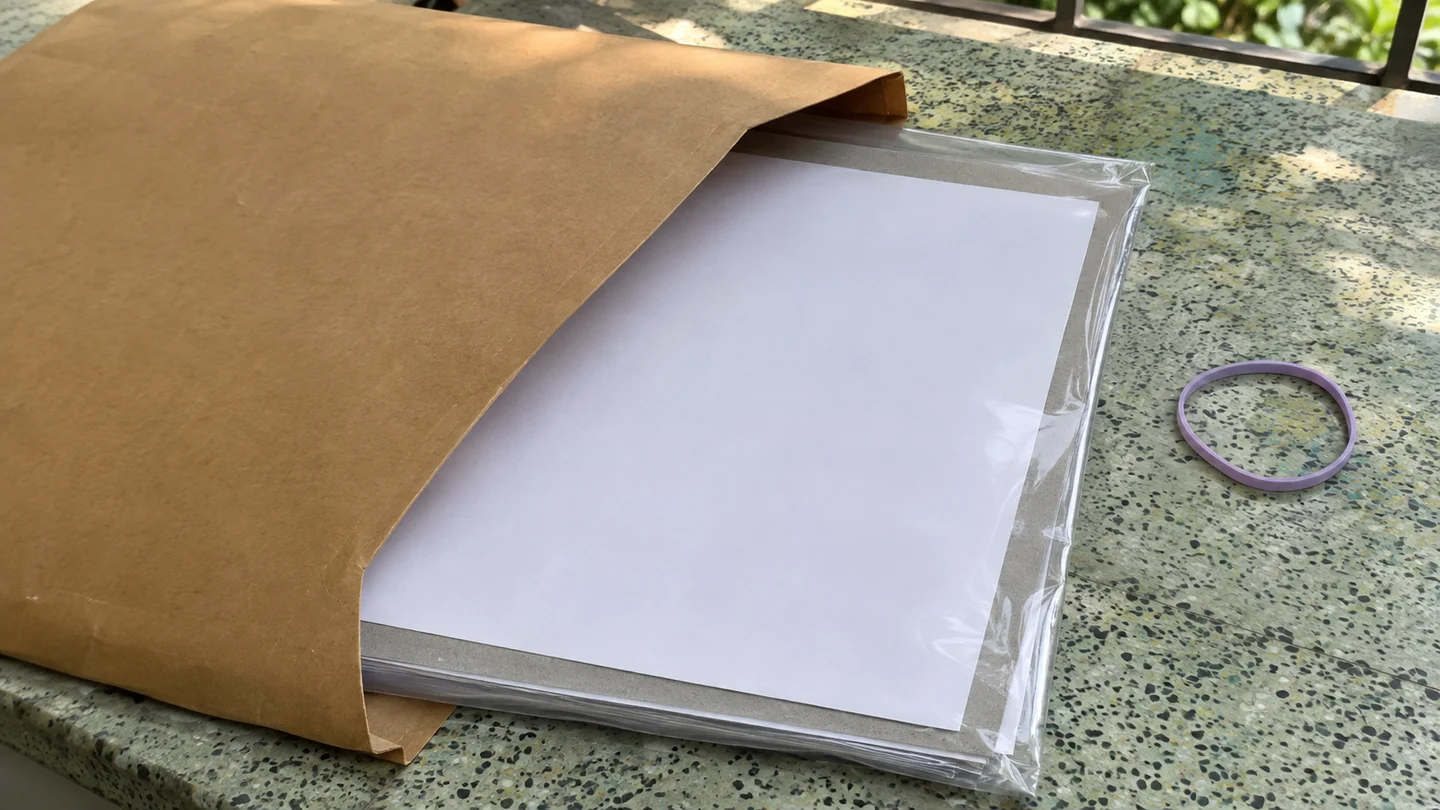
For ordinary flat papers, plan protection against bending, moisture and loose movement. A suitable sleeve and stiff backing inside a properly sized document mailer can help protect the sheets. Keep the address readable on the outside and avoid putting tape directly on an original document.
Confirm the provider's packing and inspection process before final sealing. Blue Dart's published guidance asks customers to hand packages over open and states that shipments can be security checked. Privacy does not justify concealing contents from required lawful inspection.
Ask before folding a certificate or changing its presentation. Use the recipient's handling requirements and the provider's accepted packaging. If a document has special preservation needs, obtain specialist advice rather than assuming a normal envelope is enough.
Use the parcel preparation guide to organize the packing and handoff questions. The purpose is to make the actual contents and responsibilities clear, not to turn a confidential file into a public photo demonstration.
Reference Blue Dart: Domestic Priority tracking, delivery proof and booking requirements
Plan backwards from acceptance, not from the dispatch date
Write the receiving office's deadline as a date and, if relevant, a time. Check working days, receiving hours, the correct department and the time needed for internal processing. Then ask the carrier for the service available between the exact origin and destination PIN codes on the intended booking day.
Confirm the cut-off for that booking location. An envelope dropped after a cut-off may not have the same plan as one accepted earlier. A city-level “next day” phrase should not replace a booking-specific answer about service and terms.
Keep three checkpoints: the envelope is accepted by the carrier, it reaches the delivery address, and the receiving office confirms the required acceptance. Decide who will follow up at each checkpoint and what they should do if information is missing.
If missing the deadline would have a serious consequence, do not squeeze the plan until every step has to work perfectly. Contact the institution about available alternatives or extensions and choose an arrangement whose obligations you understand. This article cannot establish legal filing or application compliance.
Compare the complete cost and the separate replacement problem
Ask for an all-in quote in INR for the finished envelope and selected service. Record which charges are included. Compare like with like: an office drop-off arrangement and a pickup service can place different travel and waiting costs on the sender.
Keep replacement effort separate from the shipping total. The cost of obtaining another original, a fresh signature or a new appointment is not necessarily the monetary value a carrier assigns to paper. Blue Dart's carriage conditions exclude commercial utility or special value when determining document value and limit liability under their terms. Read the exact terms before relying on compensation.
The worksheet below does not provide current prices. Put confirmed amounts in the relevant rows and leave unresolved amounts visible. A blank is a question to answer, not an invitation to enter zero.
| Cost or obligation | What to enter | Who confirms |
|---|---|---|
| Main shipment | All-in service quote and applicable taxes or extras | Carrier |
| Packing | Mailer, sleeve and protective backing if needed | Sender and carrier |
| Origin access | Travel to booking point or any pickup charge | Sender and provider |
| Delivery evidence | Requested proof and any applicable fee | Carrier |
| Recipient access | Collection or local travel if the plan needs it | Recipient |
| Return journey | Original return service and packing if required | Recipient and sender |
| Replacement exposure, separate from freight | What could need replacing and whether the risk is acceptable | Document owner |
Reference Blue Dart: Domestic Priority carriage conditions and document-value limitations
When an existing traveller journey is the wrong shortcut
For a permitted, replaceable set of papers with flexible timing, a compatible existing journey may be worth discussing. That still needs accurate contents disclosure, participant agreement and two practical handoffs. Do not ask someone to accept an unexplained sealed file or bypass transport restrictions.
I would not choose a traveller arrangement for irreplaceable or deadline-critical originals when it cannot provide the handling, delivery evidence or recourse the task requires. A person already travelling to the same city is not automatically providing a document courier service.
Use ParcelPool planning to understand the existing-journey model, not as a promise of a match or document acceptance. If comparing a compatible traveller arrangement, the parcel calculator helps account for contribution, preparation and local access costs. Retain your separate courier quote and document acceptance checklist.
ShipdeHop takes zero commission, now and always. That does not mean there are no travel, packing or contribution costs. Current website plans are local planning tools, not confirmed bookings or payments. Check current availability before relying on a product channel.
Send this brief before you hand over the envelope
To the receiving office: “Please confirm the exact papers required, whether originals are necessary, the receiving department and address, receiving hours, acceptance deadline and acknowledgment process. If originals must be returned, please confirm who arranges that.”
To the carrier: “This is a domestic document shipment from PIN ___ to PIN ___. It contains ___. Finished packed weight is ___ g and dimensions are ___. Please confirm acceptance, packing and inspection requirements, booking cut-off, delivery service, available proof of delivery and the full charge.”
After dispatch, keep one private record with the contents list, recipient instructions, booking reference and agreed next steps. After physical delivery, follow up for the institution's acknowledgment where needed. Close the task when the original requirement is met, not when the tracking screen becomes reassuring.
The simplest decision is often the one made before anything moves: send only what is required, choose a service that fits the evidence needed, and leave enough time for the humans at both ends.
What remains after extra expenses?
Change the amounts to match your proposed arrangement. Include every relevant expense.
Questions, answered
Can I send original certificates by courier within India?
Confirm acceptance of the exact document with the selected provider and confirm that the receiving institution actually needs the original. Review packing, delivery evidence, liability and return arrangements before dispatch. This guide does not establish eligibility for every document or service.
What is the cheapest way to send documents in India?
Compare actual all-in quotes for the finished envelope, including packing, access, evidence and any return journey. A low postage figure does not identify the best fit when originals or deadlines require particular handling. No nationwide cheapest option is established here.
Is a delivered tracking status enough for an application deadline?
Not automatically. Ask the receiving institution what counts as acceptance, where the papers must arrive and whether it issues a separate acknowledgment. Shipment tracking alone cannot establish that an application was complete or accepted on time.
Should I seal documents before visiting the courier counter?
Ask about the selected provider's inspection process first. Blue Dart's Domestic Priority page instructs customers to hand over packages open. Prepare protective materials, but follow the actual booking requirements rather than assuming every carrier accepts a pre-sealed envelope.
Sources and useful references
External source pages checked on 10 November 2026. The worked amounts are inputs for the decisions explained above.
- India Post: Domestic Speed Post Document specifications and value-added servicesChecked 10 November 2026
- Blue Dart: Domestic Priority tracking, delivery proof and booking requirementsChecked 10 November 2026
- Blue Dart: Domestic Priority carriage conditions and document-value limitationsChecked 10 November 2026

I’m building ShipdeHop around useful connections between people, journeys and pre-loved things. Zero commission. Now and always.
Why I’m building ShipdeHop →