
Consider Porter’s goods-transport options when you need a vehicle for a defined collection task, and its separate moving service when packing or substantial handling is part of the job. Consider a traveller only when an allowed, prepared parcel fits their existing route, space and handoff windows. Neither a weight limit nor a matching destination settles the decision. Confirm the exact service and availability.
“Can someone pick this up?” sounds like one job. It can mean collecting a ready box at a gate. It can also mean climbing three floors, finding packing materials and moving a piece of furniture that nobody has measured.
Those are not the same request. Putting them under the word parcel does not make them the same request either.
I am building ShipdeHop around useful existing journeys. That does not make a traveller the right answer to every transport problem. Here is how I would compare a Porter option with a traveller arrangement before getting distracted by the first attractive number.
Compare the actual service, not just the app name
Porter’s official site describes on-demand goods transport with vehicle selection, pickup and drop details. It also offers Packers and Movers as a separate service. For this comparison, that distinction matters more than treating everything under the Porter name as one interchangeable option.
ShipdeHop’s ParcelPool proposition is different: an appropriate parcel joins a willing traveller’s existing journey. It begins with compatibility, not a vehicle dispatched simply because a sender has a task.
The table summarises published service descriptions checked on 20 October 2026. It is not a completed booking test, a price survey or a finding that one service is universally better. Follow the linked official evidence and confirm the exact service offered for your request.
| Decision | Porter goods transport | Porter Packers and Movers | Traveller parcel arrangement |
|---|---|---|---|
| Starting point | Request transport for your goods | Request a moving service | Find a suitable existing journey |
| What you select or agree | Addresses, goods and suitable vehicle | Moving requirements and service package | Contents, capacity and both handoffs |
| Packing and handling | Confirm any extra assistance | Packing and moving tasks are described in this service | Do not assume either is included |
| Timing basis | Check booking details and current estimates | Confirm the agreed moving arrangement | Work around the traveller’s original itinerary |
| What needs checking now | Local service and vehicle availability | Scope and availability for the move | A willing traveller and a compatible plan |
Reference Porter official goods-transport services and booking workflow · Porter official Packers and Movers scope and handling options · ShipdeHop ParcelPool description and existing-journey planning flow · Porter published service terms covering additional assistance and timing estimates
A 20 kg label is not permission for every 20 kg object
Porter’s two-wheeler page currently displays a 20 kg capacity. It also describes point-to-point goods transportation. That gives you a published weight reference for that offering, not confirmation that any object below that weight will be accepted.
Imagine a light but very long package. Its weight may look unremarkable while its shape makes the proposed carrying arrangement unsuitable. A compact dense package creates a different question. Weight, shape, contents and how the object can be carried all matter.
Do not apply Porter’s capacity label to a private traveller. They have their own luggage, usable space and transport restrictions. Equally, do not assume that something too awkward for a traveller automatically qualifies for a particular Porter vehicle. Describe it and confirm acceptance.
Reference Porter official two-wheeler capacity and transportation description
Measure the object that will actually leave the house
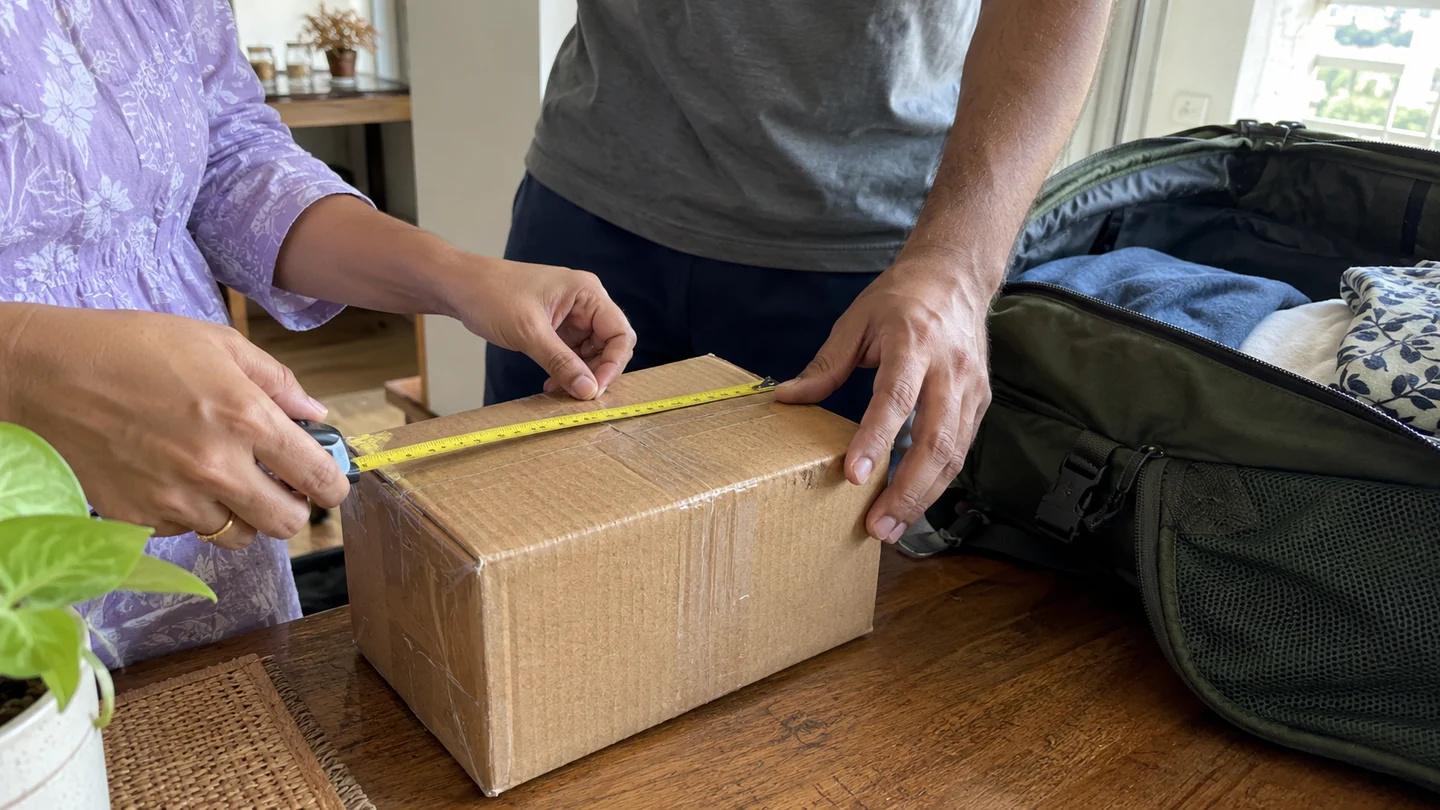
DHL Express India’s measurement guide, dated 7 April 2026, recommends measuring the outside of a fully packed, closed box on a flat surface. It also warns against missing bulges and outermost points. I am using its measurement guidance here, not importing its international shipping rates or rules into this comparison.
Write down the finished length, width and height in cm, the packed weight in kg and the number of separate pieces. If a handle, stand or protective corner changes the outline, include it in the description. Photograph the finished package alongside the measurements if that helps people understand it.
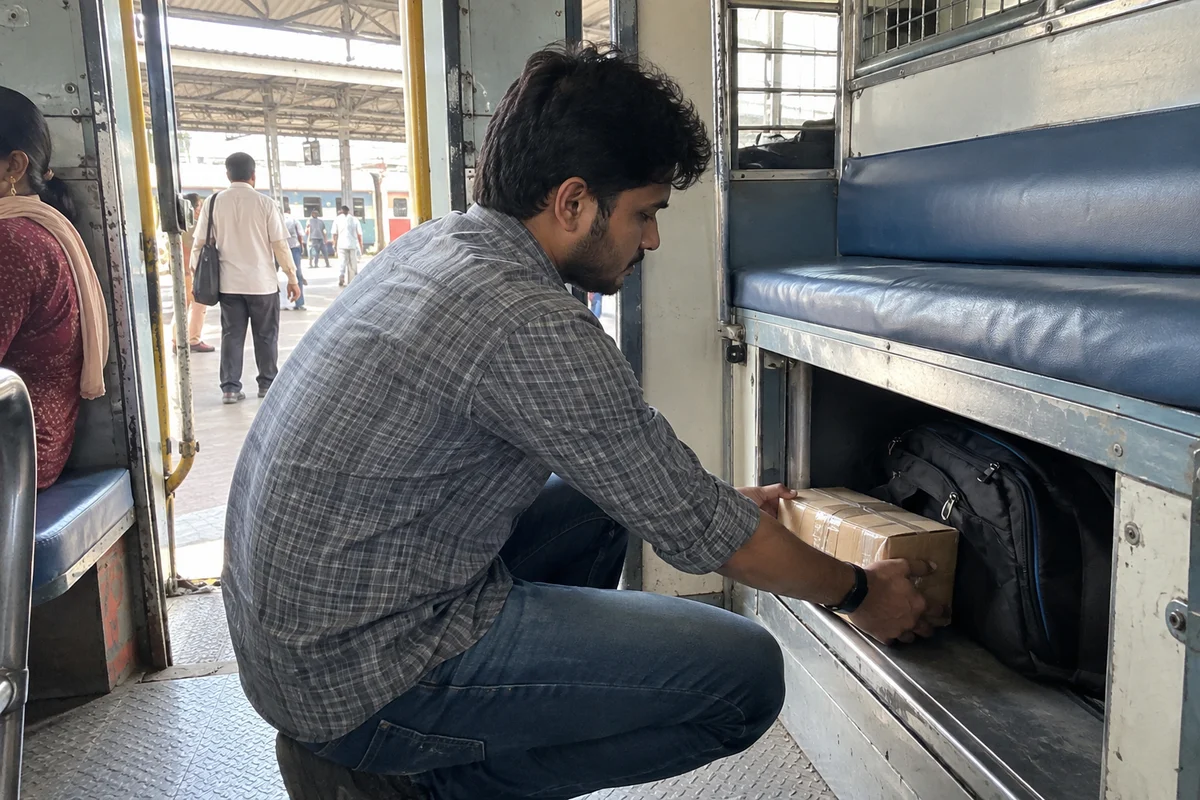
Then check the narrowest relevant point in the proposed plan. The storage space may be large enough while the opening is not. A package might fit once inside but be impossible to place there without removing the protection it needs.
For a traveller, ask about space after their own luggage is accounted for. For booked goods transport, give the same measurements when selecting and confirming a suitable vehicle. Using one consistent package description makes the comparison much less slippery.
Reference DHL Express India guidance on measuring the outside of a packed parcel, 7 April 2026
 ShipdeHop
Separate carrying the box from getting it to the vehicle
A vehicle arriving near a building does not answer who brings the item downstairs. Write down the collection floor, lift access, distance to the loading point and any assistance needed. Repeat that at the receiving end. “Doorstep” is too vague when everyone imagines a different door.
Porter’s published terms describe loading and unloading assistance as an additional service with additional charges when selected. Its Packers and Movers page describes a broader moving offering. Confirm your exact package rather than assuming that a basic vehicle request includes a moving team.
The same boundary matters with a traveller. Someone agreeing to carry a prepared parcel has not automatically agreed to pack it, dismantle it, lift a heavy object or wait while a seller finishes getting it ready.
My test is simple. If the person doing the collection would need tools, extra people or skills that have not been agreed, the request is unfinished. Resolve that gap before asking whether the transport is cheap.
Reference Porter published service terms covering additional assistance and timing estimates · Porter official Packers and Movers scope and handling options
A deadline needs an actual commitment, not optimistic wording
Porter’s two-wheeler page advertises same-day transportation, while its general terms say arrival times are estimates and do not commit to time-bound completion. Read those together. Do not turn a service description into a guarantee for your specific deadline.
With a traveller, begin with their departure and arrival plan, then check whether collection and receipt fit around it. If the parcel only works when they delay their own departure, change their route substantially or wait for an uncertain recipient, you are asking for a different journey.
Separate “I would prefer today” from “this is unusable after 5 pm”. For a hard cutoff, ask a suitable provider what commitment it can actually make, subject to its terms. Keep an alternative ready if the available options cannot meet your requirement.
I would not decide this by comparing two confident chat messages. I would decide it by identifying what is confirmed, what is estimated and what happens if the estimate slips.
Reference Porter official two-wheeler capacity and transportation description · Porter published service terms covering additional assistance and timing estimates
Run the request through four gates
Here is the practical sequence I would use. Do not let a pass at one gate compensate for a failure at another. An item that fits perfectly can still be prohibited. A permitted parcel can still have no workable recipient.
Check the selected provider’s current exclusions and ShipdeHop’s prohibited-items guidance as applicable. A rule from one service is not permission to carry the item on another service or transport mode.
- Contents gate: the item is disclosed and allowed for the selected service and actual transport mode.
- Physical gate: the finished package fits the confirmed space and can be carried appropriately.
- Handling gate: packing, access, lifting and any extra assistance have named people or an explicitly selected service.
- Timing gate: collection and receipt both work, with a clear plan if someone is late.
 ShipdeHop
Three requests that lead to different next steps
These are hypothetical tasks, not live listings, quoted services or customer stories. The point is to show how one changed requirement can change the kind of help you should investigate.
Suppose a prepared box is ready at a public meeting point and the recipient can meet during a traveller’s existing arrival window. That is worth a compatibility conversation. It is not proof that a matching traveller exists.
Now change the task to an unpacked item upstairs with no agreed lifting help. The unresolved work is no longer merely transport. Or keep the small box but give it an inflexible deadline. The box has not changed, but the decision has.
| Hypothetical request | Decisive question | Useful next step |
|---|---|---|
| Ready box, flexible handoffs, possible existing journey | Does the actual traveller accept the full arrangement? | Check suitability before agreeing |
| Awkward item upstairs, packing and lifting unresolved | Who performs the preparation and handling? | Ask about a suitable moving service or explicit help |
| Small permitted parcel with a hard deadline | What timing commitment is actually available? | Seek confirmed terms and a workable fallback |
Send one brief before asking for two prices
Use the same task description for every option. Otherwise, one person may be pricing a collection from the gate while another is being asked to bring an object down several floors. The cheaper reply might simply cover less work.
Try this: “I need to move [disclosed item], packed as [number of pieces], measuring [cm] and weighing [kg]. Collection is at [area, floor and access], ready during [window]. Receipt is at [area and access] during [window]. Packing is handled by [person]. Loading and unloading need [help]. My deadline is [time or flexible]. Please confirm suitability, included work, extra charges and what happens if the plan changes.”
For a traveller, add their original route and the agreed meeting points. Do not ask them to quote an imaginary trip on the assumption that somebody must be going your way.
Only then compare the amounts and remaining work. Our parcel total-cost guide covers that separate step. ShipdeHop takes zero commission, now and always, but that does not remove packaging, collection costs or an agreed traveller contribution.
Where I would start on ShipdeHop
Use the ParcelPool planner to describe the item and the proposed handoffs. If you are already travelling, the Carry guide helps you decide what would reasonably fit your own trip.
Check current product availability before taking action. ShipdeHop’s website plans do not create live matches or bookings, and the published status says production payments and live escrow are not currently available. A route page is not evidence of an available traveller. This comparison concerns domestic India planning.
My view is straightforward. Choose the kind of help the task needs. A shared journey can be useful precisely because it already exists. If making the parcel fit requires inventing a new journey or an unagreed moving service, choose another arrangement.
Reference ShipdeHop current published availability and payment limitations
Use the savings and contribution calculators with your own costs.
Questions, answered
Is Porter the same thing as parcel pooling?
No. Porter describes goods-transport services with vehicle and task selection, as well as a separate moving service. Parcel pooling considers whether a suitable parcel can join someone’s existing journey. Compare the required work, confirmed capacity and timing rather than treating the models as identical.
Can a parcel under 20 kg always go by two-wheeler?
No. Porter’s two-wheeler page displays that weight capacity, but weight alone does not establish suitability. Confirm the contents, shape, packed dimensions and acceptance for the selected service. The figure is not a capacity promise for a private traveller.
Does a goods-vehicle booking automatically include loading help?
Do not assume it does. Confirm the selected service and exact assistance. Porter describes additional loading and unloading services separately in its terms. A traveller also needs to agree explicitly to any help beyond carrying the disclosed, prepared parcel.
Which option is cheaper for my parcel?
You need comparable confirmed details before answering. Use the same package, access, handling and timing brief, then compare each option’s full amount and any work left for you. A starting fare and a traveller contribution are not automatically equivalent offers.
What should I do if the parcel must arrive at a fixed time?
Ask a suitable service what timing commitment it actually offers under its terms, and prepare a fallback. Do not treat a marketing description, estimated arrival or a possible traveller as a guaranteed deadline. Decline an arrangement that cannot meet your essential requirement.
Sources and useful references
External source pages checked on 20 October 2026. The worked amounts are inputs for the decisions explained above.
- Porter official goods-transport services and booking workflowChecked 20 October 2026
- Porter official two-wheeler capacity and transportation descriptionChecked 20 October 2026
- Porter official Packers and Movers scope and handling optionsChecked 20 October 2026
- Porter published service terms covering additional assistance and timing estimatesChecked 20 October 2026
- DHL Express India guidance on measuring the outside of a packed parcel, 7 April 2026Checked 20 October 2026
- ShipdeHop ParcelPool description and existing-journey planning flowChecked 20 October 2026
- ShipdeHop current published availability and payment limitationsChecked 20 October 2026

I’m building ShipdeHop around useful connections between people, journeys and pre-loved things. Zero commission. Now and always.
Why I’m building ShipdeHop →