
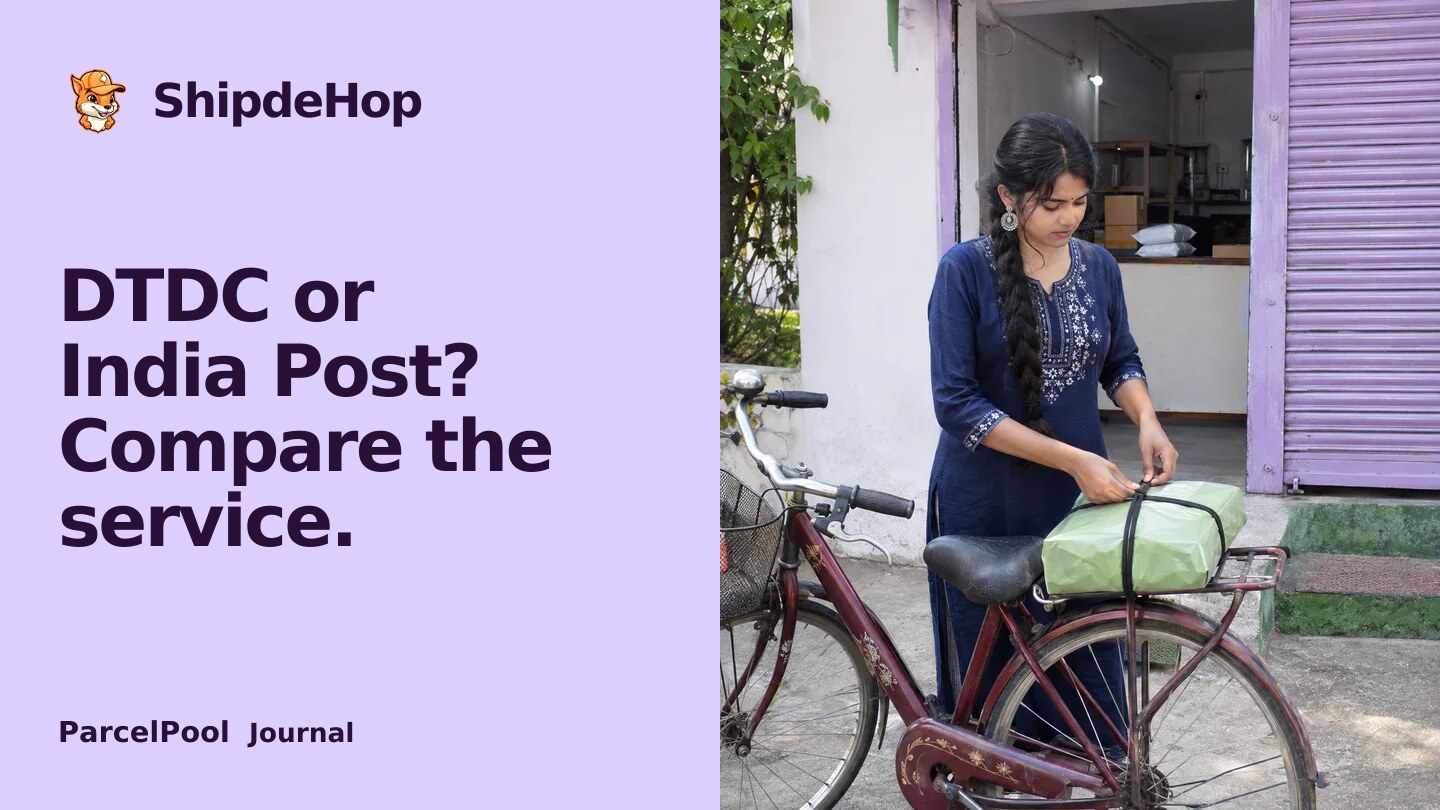
Compare DTDC with the specific India Post product you would actually book, not with a generic postal price. Check both PIN codes, the packed parcel’s weight and dimensions, the expected arrival and the complete bill. DTDC offers pickup and drop-off options, while India Post Parcel and Speed Post have different transmission and tariff rules. Neither is always the best choice.
A parcel comparison can go wrong before you enter a weight. One person quotes a postal surface product, another selects an express courier option, and somebody else remembers what a friend paid last year. Those are three different questions wearing the same label.
I would start with the parcel you have today and the result you need at the other end. This guide is for an occasional sender within India, not a business negotiating a monthly shipping contract. It compares DTDC’s personal-courier proposition with India Post Parcel Retail and Speed Post Parcel.
All product pages and the tariff example below were checked on 9 November 2026. They are published provider information, not a service test, a live booking or a promise about your address.
DTDC versus India Post: first name the postal product
DTDC’s Personal Courier page offers online booking, doorstep pickup or access-point drop-off, and shipment tracking. It says pricing depends on weight, dimensions, distance and service choice. Check your exact origin and destination in the booking flow before relying on those options.
India Post Parcel Retail is a separate product from Speed Post Parcel. The official Retail page says it ordinarily travels by surface. The Speed Post Parcel page describes air transmission, with surface allowed when determined faster and priority over India Post Parcel when travelling by surface.
That distinction matters more than a broad statement that post is slow or courier is fast. Ask for the actual product name on each quotation. Then compare whether its current route estimate fits your deadline.
The table uses DTDC’s own Personal Courier and service-guide pages alongside the two official India Post product pages. Planning questions in the final row are my decision framework, not extra provider features.
| Check | DTDC Personal Courier | India Post Parcel Retail | Speed Post Parcel |
|---|---|---|---|
| Booking approach | Online booking with pickup or access-point drop-off options | Postal parcel product with window-booking requirements on its page | Separate postal parcel product with its own requirements |
| Transmission evidence | Confirm the selected service and mode | Ordinarily surface | Air, or surface when determined faster, with priority over ordinary parcel |
| Rate evidence | Quote depends on weight, dimensions, distance and service | Published Retail tariff table by weight and zone | Separate Retail and Contractual tariff tables |
| Tracking evidence | Tracking number described on Personal Courier page | Described as an accountable item | Online track and trace described |
| What to confirm locally | PIN-code serviceability, pickup slot and complete quote | Office acceptance, product eligibility and current bill | Office acceptance, chosen tariff and expected arrival |
| Decision | Can this specific offer complete my task? | Does this product fit my timing and booking effort? | Does its service fit my deadline at the complete cost? |
Reference DTDC Personal Courier: booking options, pricing factors and tracking, checked 9 November 2026 · DTDC official service guide: volumetric weight and carriage information, checked 9 November 2026 · India Post Parcel Retail: product rules and tariff effective 1 August 2026, checked 9 November 2026 · India Post Speed Post Parcel: product features and Retail tariff, checked 9 November 2026
A current tariff example is useful only with its labels attached
Here is one narrow, sourced comparison within India Post. On the official pages checked on 9 November, the Retail tariff for the 1,501–2,000 gram slab in the Other States column is ₹239 for India Post Parcel and ₹319 for Speed Post Parcel. Both tables say GST applies. The displayed tariffs are effective from 1 August 2026.
Those figures are not a DTDC quote, not an all-inclusive bill and not a recommendation for a named route. Your final packed parcel must fall in the applicable slab, and the booking office must establish the correct classification and chargeable basis. A label saying 2 kg before packaging is not enough.
The Speed Post page also separates Retail from Contractual tariffs. An occasional sender should not borrow the contractual row to make a personal comparison look cheaper. Confirm the tariff you qualify for.
My point is not that an ₹80 difference decides the shipment. It is that the product, slab, zone, eligibility and tax treatment have to stay attached to a number. A screenshot with those labels cropped off is poor evidence.
| Published tariff snapshot | India Post Parcel Retail | Speed Post Parcel Retail |
|---|---|---|
| Weight slab and zone | 1,501–2,000 g, Other States | 1,501–2,000 g, Other States |
| Displayed tariff | ₹239 | ₹319 |
| GST | As applicable, additional to displayed tariff | As applicable, additional to displayed tariff |
| Effective date on page | 1 August 2026 | 1 August 2026 |
| Not established by this example | Your final charge or arrival date | Your final charge or arrival date |
Reference India Post Parcel Retail: product rules and tariff effective 1 August 2026, checked 9 November 2026 · India Post Speed Post Parcel: product features and Retail tariff, checked 9 November 2026
Make one parcel card before requesting two quotes
Describe the contents specifically. Two folded cotton shirts, paperback books and a fragile camera are different acceptance and packing questions. Do not just type personal items and expect a useful answer.
Pack appropriately before recording weight in kg and outside length, width and height in cm. Include the box, cushioning and closures. If a package is not final yet, mark the measurements provisional and obtain a revised quote after packing.
DTDC’s service guide distinguishes air and surface volumetric calculations. Its terms also allow differential charges where actual or volumetric weight exceeds what was declared. Ask the booking channel to confirm the applicable chargeable weight rather than importing one divisor from a general shipping blog.
Give both providers the same sending and receiving PIN codes, contents, packed measurements, declared value and required arrival. Record any stated acceptance limitation. One successful quote form does not establish that an unusual item will be accepted at handover.
Use the parcel guide to prepare the contents and packaging questions. Then confirm the selected provider’s own rules. ShipdeHop’s guidance does not override a postal or courier restriction.
- Contents and quantity, with anything fragile or restricted disclosed
- Final packed weight in kg and outside dimensions in cm
- Origin and destination PIN codes plus full address details
- Required arrival date, not just a preferred dispatch date
- Declared value and evidence of value if requested
- Selected product, quoted chargeable weight and quote date
Reference DTDC official service guide: volumetric weight and carriage information, checked 9 November 2026 · DTDC terms: weight differences, carriage conditions and restrictions, checked 9 November 2026
Compare the bill and the work needed to book it
I would keep the provider’s payable bill separate from my own first-mile expense. The first is what the courier or post office charges. The second is what it takes me to get the parcel into that system.
Record carriage, applicable taxes, required surcharges and any optional service you actually choose. Ask what is already included. Packaging, insurance and proof-of-delivery requests need explicit answers, not automatic assumptions that every option is free or compulsory.
Now record the journey to the booking point if you are dropping off. If you choose pickup, check the real slot and whether someone can be present. A convenient advertised facility is not a confirmed collection appointment.
Time belongs beside the rupees, but it does not need an invented hourly wage. List travel, queue or pickup-waiting time in minutes. If the cheaper bill requires effort you cannot manage that day, that is a legitimate reason to choose differently.
| Same-parcel quote card | DTDC offer | Chosen India Post product |
|---|---|---|
| Product, quote date and PIN pair | Write the exact details | Write the exact details |
| Packed and chargeable weight | Confirm both | Confirm both |
| Carriage and applicable tax | ₹___, included or excluded? | ₹___, included or excluded? |
| Required or chosen extras | Itemize, or confirm none | Itemize, or confirm none |
| Provider’s payable total | ₹___ confirmed | ₹___ confirmed |
| Own drop-off transport or other first-mile spend | ₹___ or not needed | ₹___ or not needed |
| Booking effort | ___ minutes and accepted slot | ___ minutes and office hours |
| Arrival information | Estimate or specific commitment? | Estimate or specific commitment? |
| Unresolved question | List it, do not enter ₹0 | List it, do not enter ₹0 |
Choose by the constraint you cannot move
If the arrival date is the hard constraint, start there. Ask which accepted product can meet the requirement on the actual route, from the actual booking time. An estimate on a general page is not a guarantee for your parcel.
If getting to a counter is the hard constraint, investigate a confirmed pickup option first. If the recipient is at an address that needs clearer directions, establish the correct delivery office or provider serviceability before spending time on price comparisons.
If replacement would be difficult, read the protection, exclusion and claims requirements before dispatch. Do not assume a declared value means automatic reimbursement. Retain the booking receipt, contents evidence and any documents the provider requires.
DTDC’s terms describe conditions of carriage, additional protective services and restrictions. Read the relevant terms for your chosen shipment. I would not send an item whose acceptance or responsibility remains unclear merely because a quotation looks attractive.
A flexible parcel gives you more room to compare costs. An inflexible parcel needs a firmer service answer. Neither case justifies calling one entire network the winner.
Reference DTDC terms: weight differences, carriage conditions and restrictions, checked 9 November 2026
Where a traveller arrangement belongs in this comparison
After comparing courier and postal options, a small suitable parcel may also fit somebody’s existing domestic journey. That is a different arrangement, not another postal service tier.
ParcelPool requires agreement between the sender, traveller and recipient about disclosed contents, space and both handoffs. It should not inherit a courier’s tracking, compensation, insurance or delivery commitments by association.
I would consider it only when the parcel is permitted, the journey already exists and all three people can agree a workable handoff plan. If you need a formal shipping product with specific carrier obligations, keep comparing the appropriate provider services.
ShipdeHop takes zero commission, now and always. The traveller’s agreed contribution, packing and your own connecting travel are still separate costs. There is no verified saving until you compare the whole task.
Use the calculators to put the relevant amounts side by side. The parcel calculator is for traveller contribution and expenses, not a DTDC or India Post tariff engine. Keep your courier and postal quotations as the separate alternatives.
My final booking check
Before paying, I want the service name, accepted contents, packed dimensions, payable total and expected delivery information attached to one booking. Save that record. Do not rely on an unrelated rate chart or a verbal promise from somebody who is not handling the shipment.
Tell the recipient which arrangement you actually selected and what they need to do. Confirm the address and contact details through your normal channel. Keep login codes and sensitive identity information out of informal parcel conversations.
The website’s planning tools remain browser-local plans, not live matching, bookings or payments. The iPhone app is available and Android is coming soon. Check product availability before interpreting a planning page as an available traveller or shipping appointment.
My choice would be the accepted service that meets the parcel’s real constraint at a confirmed complete cost. Sometimes that will be DTDC. Sometimes it will be a particular India Post product. A useful comparison makes that decision clearer without pretending to know your final quote.
What remains after extra expenses?
Change the amounts to match your proposed arrangement. Include every relevant expense.
Questions, answered
Is DTDC cheaper than India Post for a domestic parcel?
There is no universal answer. Compare a current DTDC quote with the applicable India Post product and tariff for the same packed parcel, PIN pair and required arrival. Include tax, selected extras and your own drop-off expenses.
Are India Post Parcel and Speed Post Parcel the same service?
No. India Post lists them separately. Parcel Retail ordinarily travels by surface, while Speed Post Parcel has different transmission provisions and separate tariffs. Confirm the exact product when booking.
Does the ₹239 India Post example include everything?
No. It is the displayed Parcel Retail tariff for the 1,501–2,000 gram Other States slab on the page checked on 9 November 2026. GST applies, and eligibility, chargeable weight and chosen additions need confirmation.
Should I weigh a parcel before or after packaging?
Use the final packed weight and outside dimensions for the comparison. Provisional figures can change after protective packaging. Ask the provider to confirm its applicable chargeable-weight rule.
Can I assume DTDC will collect from my home?
No. Its Personal Courier page advertises pickup options, but you still need to confirm serviceability and an available slot for your actual address. A product page is not a collection appointment.
Is ShipdeHop ParcelPool an India Post or DTDC service?
No. It is a separate existing-traveller arrangement requiring agreement on contents and both handoffs. ShipdeHop’s web plans do not create a courier booking or provide those carriers’ service commitments.
Sources and useful references
External source pages checked on 9 November 2026. The worked amounts are inputs for the decisions explained above.
- DTDC Personal Courier: booking options, pricing factors and tracking, checked 9 November 2026Checked 9 November 2026
- DTDC official service guide: volumetric weight and carriage information, checked 9 November 2026Checked 9 November 2026
- DTDC terms: weight differences, carriage conditions and restrictions, checked 9 November 2026Checked 9 November 2026
- India Post Parcel Retail: product rules and tariff effective 1 August 2026, checked 9 November 2026Checked 9 November 2026
- India Post Speed Post Parcel: product features and Retail tariff, checked 9 November 2026Checked 9 November 2026

I’m building ShipdeHop around useful connections between people, journeys and pre-loved things. Zero commission. Now and always.
Why I’m building ShipdeHop →