

The cheapest way to send a parcel in India depends on the packed weight, destination and deadline. Start with a current postal quote, compare a personal-courier quote for the same parcel, and consider parcel pooling if a suitable traveller is already making that journey. Choose the lowest practical total among options that actually accept your item and meet your needs.
You have a few books to send home. Or a jacket your friend left behind. Or something small that needs to reach another city without costing more than the thing inside the box. That is a different problem from running an online store, but many cheap-courier lists treat both as the same job.
I would not start with a list of ten companies and declare a winner. Start with your parcel. Three decisions make the shortlist much shorter: whether it can wait, whether somebody can collect it, and whether the sender needs a booked delivery service or can coordinate a suitable existing journey. Here is how I would choose.
Choose the option around the parcel
A student sending ordinary books next week has different priorities from someone sending an essential original document for a fixed appointment. The first person can compare slower options. The second needs a confirmed service scope and a realistic deadline before looking at the cheapest price.
Use the table as a shortlist, not as a promise of price or availability. India Post describes its retail parcel product as ordinarily surface-transmitted. Delhivery offers a personal-courier booking flow. ShipdeHop ParcelPool connects an appropriate parcel with somebody already travelling that way. These are different arrangements, not interchangeable versions of one service.
For a rail or bus option, first ask the actual operator whether it accepts the item on that route, where booking and collection happen, and which receipt or identification is required. A passenger timetable alone is not evidence of a parcel service. Do not hand a package to an unknown person because a vehicle is leaving soon.
| Option | Worth checking when | Confirm before choosing |
|---|---|---|
| Postal parcel | The deadline allows a postal journey and you can arrange booking | Current tariff, item acceptance, packaging and delivery scope |
| Personal courier | A booked pickup and delivery flow matters to you | PIN-code eligibility, billed weight, final quote and delivery terms |
| Rail or bus parcel service | An actual operator confirms a suitable service | Booking point, collection point, receipt, charges and restrictions |
| Parcel pooling | A suitable traveller already has a compatible route and space | Disclosed contents, agreed contribution and both handoffs |
Reference India Post: retail parcel service, tariff and conditions · Delhivery: official personal courier service
Pack once, then compare the same parcel
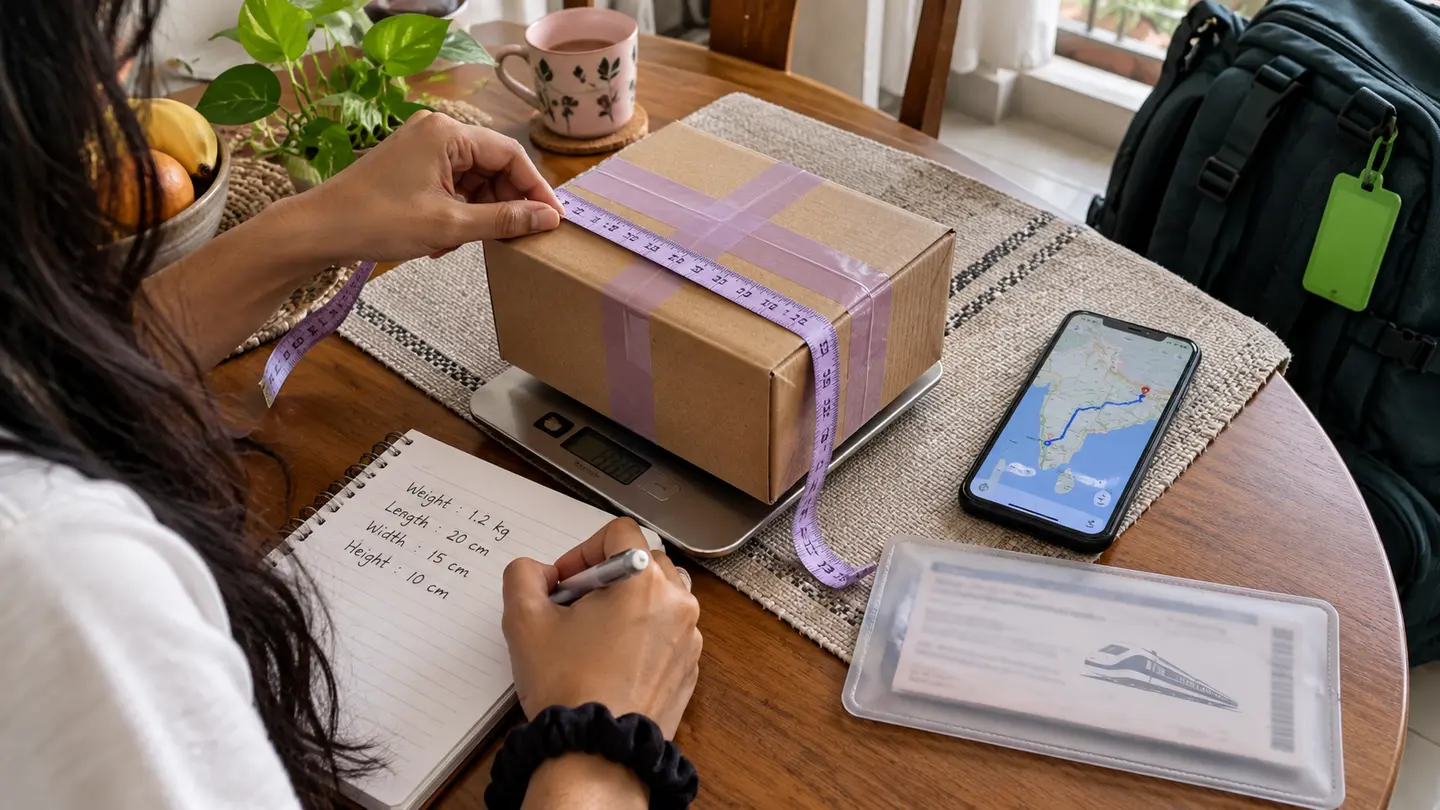
Do the boring measurement once so you do not have to do the decision twice. Put the item into the packaging you will actually use. Include the padding, tape and outer box. Record the total weight in kg and the outside length, width and height in cm. A product listing's dimensions are not necessarily the dimensions of the packed box.
Delhivery Direct's published terms calculate charged weight using the higher of physical weight and volumetric weight, with a stated divisor of 5,000 for dimensions in cm. That is evidence for its service, not permission to apply one formula to every carrier. Ask each provider which rule applies to your booking.
If the box is mostly air, consider a smaller suitable box. Do not remove necessary protection simply to fit a cheaper slab. Books still need protection from moisture and movement, and a fragile object does not become appropriate for traveller carriage just because it fits inside a backpack. Read the item rules before choosing any transport arrangement.
- Write the contents specifically, such as three used textbooks, rather than personal items.
- Weigh the parcel after packing, not just the loose contents.
- Measure all three outside dimensions with the box closed.
- Keep the origin and destination PIN codes beside the measurements.
- State the latest useful arrival date and whether anybody can collect locally.
- Check the item rules before seeking a quote or a traveller.
Reference Delhivery Direct: booking, charged weight and shipping terms
Use the postal tariff as a real starting point
India Post's official retail-parcel page provides a useful reference instead of an unexplained starting-from number. Checked on 25 October 2026, it lists ₹65 for the within-state slab up to 500 grams and ₹91 for 501 to 1,000 grams, with GST applicable. The page states that these tariffs took effect on 1 August 2026. Confirm the correct product, zone and current amount before booking.
That gives you something concrete to compare. It does not make post the cheapest answer for every parcel. Your item must qualify, the packaging must comply, and the service must suit the deadline. Do not take a surface-parcel tariff and assume it buys a different postal product or an urgent delivery commitment.
My rule is simple: get one valid baseline before shopping around. A price found in a social post from last year is not a baseline. Neither is a business-account rate that you cannot access for your one-off personal parcel.
Reference India Post: retail parcel service, tariff and conditions
Ask for a personal quote, not an ecommerce headline
Many search results are written for sellers shipping repeatedly. Their prices may depend on account type, volume, payment method or service eligibility. If you are sending one jacket, ask whether the quoted rate is available to an individual making one booking. That question saves more effort than collecting a dozen screenshots.
Delhivery's personal-courier page describes doorstep pickup and a booking-and-tracking flow. Check the current booking result for your actual PIN codes and parcel details. Do not read same-day pickup as same-day delivery. They describe different events.
Before paying, look at the final amount and the responsibilities attached to it. Who packs the box? What happens if the weight is different? What evidence is needed if it arrives damaged? You do not need to study every policy in India. You do need to understand the policy for the service you are about to buy.
Reference Delhivery: official personal courier service · Delhivery Direct: booking, charged weight and shipping terms
When an existing journey is the better connection
Parcel pooling starts with a different question: is somebody already going close enough to the destination, with suitable space and willingness to carry the disclosed item? If the answer is no, there is no useful match to compare. A map showing the same two city names is only the beginning.
This is where I see ShipdeHop fitting into everyday life. A compatible traveller may provide another option for a small suitable parcel. The sender, traveller and recipient still need to agree the contents, timing, contribution and exchange locations. ShipdeHop takes zero commission, now and always. An agreed traveller contribution and other actual expenses can still exist.
Try the ParcelPool planner when you know what you want to send. For a journey such as Bengaluru to Mysuru, the route page helps you prepare a specific request. Neither website page is proof that a traveller is available today. Confirm the real arrangement in the app before treating it as settled.
Do not build a time-critical plan around somebody who has not accepted it. For emergency, temperature-sensitive, high-value or specially handled items, choose an appropriately qualified service. A convenient connection should not be asked to do a specialist's job.
A one-message brief that gets a useful answer
Instead of sending can you take one small thing and revealing the details later, make the request usable from the first message. The traveller should be able to say whether the parcel fits without playing twenty questions. A courier quote should use the same facts.
Copy this structure and replace every bracket: I need to send [contents] from [area and PIN code] to [area and PIN code]. Packed size is [length × width × height cm] and weight is [kg]. It needs to arrive by [date and time]. I can hand it over at [general meeting area and time window]. The recipient can collect at [general area and time window]. Please confirm acceptance, the full amount and what happens if the plan changes.
Keep sensitive identity details and exact private addresses out of public listings. Share only what the chosen secure workflow requires. The safety guidance explains why identity, contents and handoff checks are separate. A verification badge is not a substitute for an honest description or a workable exchange.
Make the final choice without turning it into homework
Keep just two or three suitable options. Cross out anything that cannot accept the contents, cannot meet the useful deadline, or leaves collection unresolved. Then compare what you would actually pay and what you would need to do. You do not need a spreadsheet to notice that a distant collection point defeats the purpose.
If the amounts are close, choose the arrangement that creates less uncertainty for the people involved. If a traveller option requires a major detour, a paid trip across the city and a second person waiting around, it may not be the useful connection you hoped for. If the exchange genuinely fits an existing journey, it may deserve a closer look.
The calculators are optional if you want to check your own numbers. The important next action is simpler: describe the parcel properly, check one postal option and one personal-courier option, then see whether an existing journey fits. Pick the lowest practical total among suitable choices, not the most attractive number on a banner.
Use the savings and contribution calculators with your own costs.
Questions, answered
Which is the cheapest way to send a 1 kg parcel in India?
There is no single cheapest option for every 1 kg parcel. Use the packed weight, outer dimensions, destination PIN code and deadline to obtain comparable quotes. Check a current postal tariff and a personal-courier quote, then consider parcel pooling only if a suitable traveller and both handoffs are confirmed.
Can I send a parcel with someone travelling by car, bus or train?
Only when the person accepts the disclosed item, it fits their journey and capacity, and the actual transport operator permits that carriage. A passenger ticket does not override restricted-item or luggage rules. Agree sender and recipient handoffs before the person takes possession.
Is parcel pooling always cheaper than a courier?
No. A suitable existing journey may be worth comparing, but the agreed contribution, collection arrangements and any extra travel affect the result. ShipdeHop does not promise the lowest price or a match on every route. Choose based on the actual accepted arrangement.
Does a same-day pickup mean my parcel arrives the same day?
No. Pickup is collection from the sender. Delivery is receipt at the destination. Check the exact service commitment and route eligibility before relying on either phrase. For a traveller arrangement, confirm departure, journey timing and recipient availability separately.
What should I do if I cannot find a suitable traveller?
Choose another suitable transport option or a later date if the deadline allows it. Do not conceal the contents, pressure a traveller or accept an unsuitable handoff just to make a match happen. A postal or booked courier service may be the better fit for that parcel.
Sources and useful references
External source pages checked on 25 October 2026. The worked amounts are inputs for the decisions explained above.
- India Post: retail parcel service, tariff and conditionsChecked 25 October 2026
- Delhivery: official personal courier serviceChecked 25 October 2026
- Delhivery Direct: booking, charged weight and shipping termsChecked 25 October 2026

I’m building ShipdeHop around useful connections between people, journeys and pre-loved things. Zero commission. Now and always.
Why I’m building ShipdeHop →