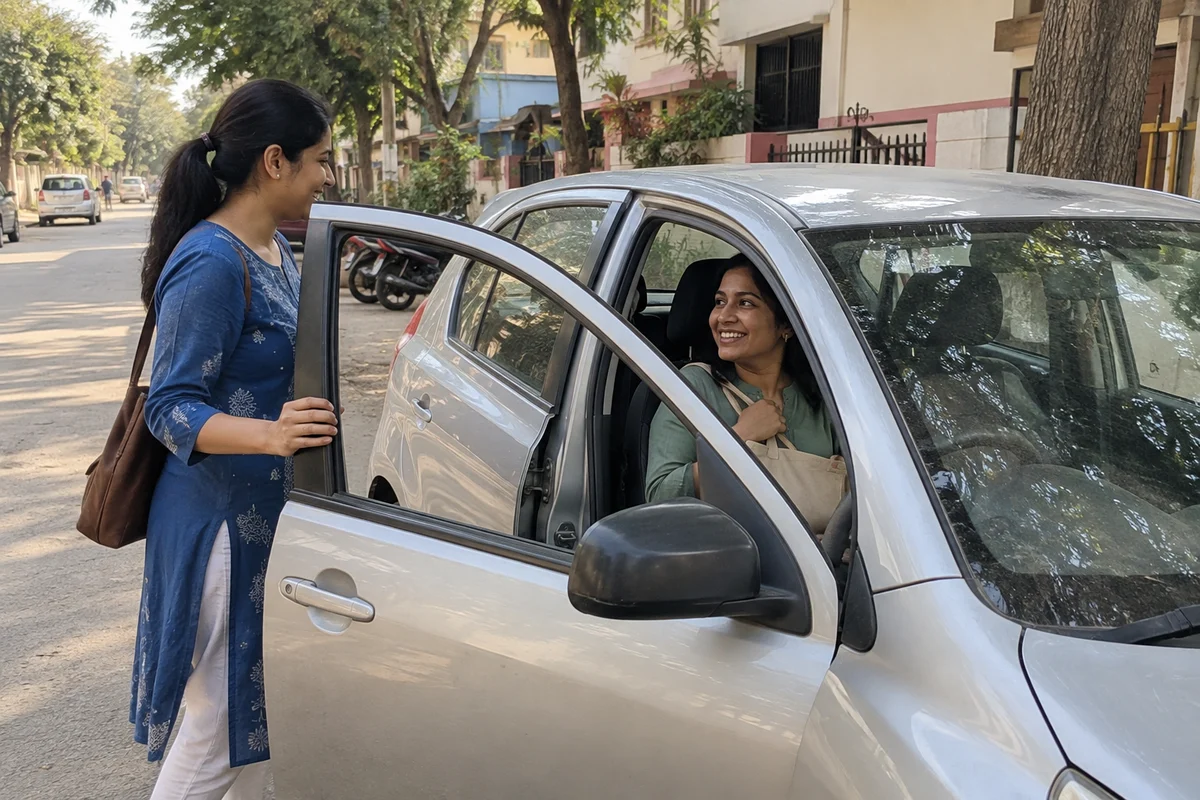
Do not compare BlaBlaCar and ShipdeHop only by the contribution shown for the shared part of a ride. Compare the itinerary that has actually been accepted: your first leg to pickup, the shared route, the last leg from drop-off, luggage fit, timing and fallback. BlaBlaCar currently offers standard meeting-point search and an optional Zen door-to-door request where available and accepted. ShipdeHop should be judged as a zero-commission CarPool planning and cost-sharing option around an existing journey, with current availability checked before relying on a route.
“BlaBlaCar vs ShipdeHop” sounds like a simple app comparison. It is not. The useful comparison is between two accepted journey plans.
A ride can look suitable between Bengaluru and Mysuru but still fail at the first 8 km, the last 6 km or the moment three suitcases meet one small boot. A city pair is not a complete itinerary.
My rule is direct: compare from your actual front door to your actual destination. Put pickup, drop-off, luggage, total time, total outlay and fallback on one sheet. If any essential cell is blank, you are not ready to choose.
First compare what the two products actually describe
BlaBlaCar’s current India search asks for From, To, departure date, return date and passenger count. Its driver page says a driver publishes departure and arrival points, the date and a recommended passenger contribution, then reviews booking requests. That is a clear shared-ride search and publishing flow.
BlaBlaCar also describes Zen as an optional door-to-door form of carpooling. A passenger can request chosen departure and arrival addresses from a driver who has enabled flexibility. The driver reviews the request and decides whether the detour suits the existing route and schedule. A regular carpool with a meeting point remains another option.
ShipdeHop’s proposition is also cost sharing around an existing journey, not an on-demand taxi promise. Its platform commission is zero, always. The current website provides planning tools and route context, the iPhone app is available, and Android is coming soon. That does not mean every route or time has a matching ride. Check the current availability page before building the rest of your day around one.
So this is not a table of who is universally better. It is a table of what you must verify before either option becomes useful.
| Decision question | BlaBlaCar official description | ShipdeHop current role | What the traveller must verify |
|---|---|---|---|
| How does search begin? | From, To, date and passenger count | CarPool service and India route-planning pages | Actual origin, destination and travel date |
| Is door-to-door included? | Zen can be requested from eligible flexible drivers. Regular meeting-point rides remain available. | Do not assume pickup at your door. Agree the actual pickup and drop. | The points accepted for this specific journey |
| What is the driver doing? | Sharing a planned ride and reviewing requests | Sharing costs around an existing journey | Whether the request fits the route without turning it into a taxi job |
| How are costs framed? | The driver page describes dividing tolls, fuel or electricity and avoiding profit from carpooling | Zero platform commission. Ride contribution and first or last mile costs remain separate. | The complete passenger outlay, not one headline number |
| Is a route guaranteed? | Search results depend on current published rides and accepted requests | Current route availability must be checked | A real accepted match for the required date and time |
Reference BlaBlaCar India official carpool search · BlaBlaCar India official Zen door-to-door carpooling page · BlaBlaCar India official offer-seats and cost-sharing page
Use the accepted-itinerary scorecard
The accepted itinerary is the version both people have actually agreed to. It is not the city name in a search card. It includes the exact pin, the meeting window, the passenger count, the luggage, the contribution and the final drop.
Start with four legs: home to pickup, pickup to drop in the shared car, drop to final destination, and the fallback if the plan changes. Google Maps advises checking when to leave, expected traffic, route choices and disruptions before a drive or transit trip. Use current directions for each leg, then verify any bus, metro or other first-mile option against its own live timetable.
Write money and time separately. Total passenger outlay equals first-leg cost plus the agreed ride contribution plus last-leg cost plus any fallback budget you choose to reserve. Total journey time equals first-leg time plus waiting buffer plus shared-drive time plus last-leg time. Do not enter ₹0 or zero minutes merely because a figure is unknown.
The ShipdeHop CarPool planner can help organise the shared part. The earlier door-to-door CarPool worksheet explains how to compare complete cost and time. Neither page can confirm a live seat by itself. Use the app and the people involved for the actual arrangement.
- Home or starting-area pin
- Exact pickup pin, gate and safe waiting point
- Agreed pickup window and message-before-departure rule
- Shared route and any accepted stop
- Exact drop pin
- First-leg and last-leg transport
- Ride contribution and payment expectation
- Fallback if the driver or passenger cannot travel
Reference Google Maps Help official trip-planning guidance
 ShipdeHop
One suitcase can change the whole answer
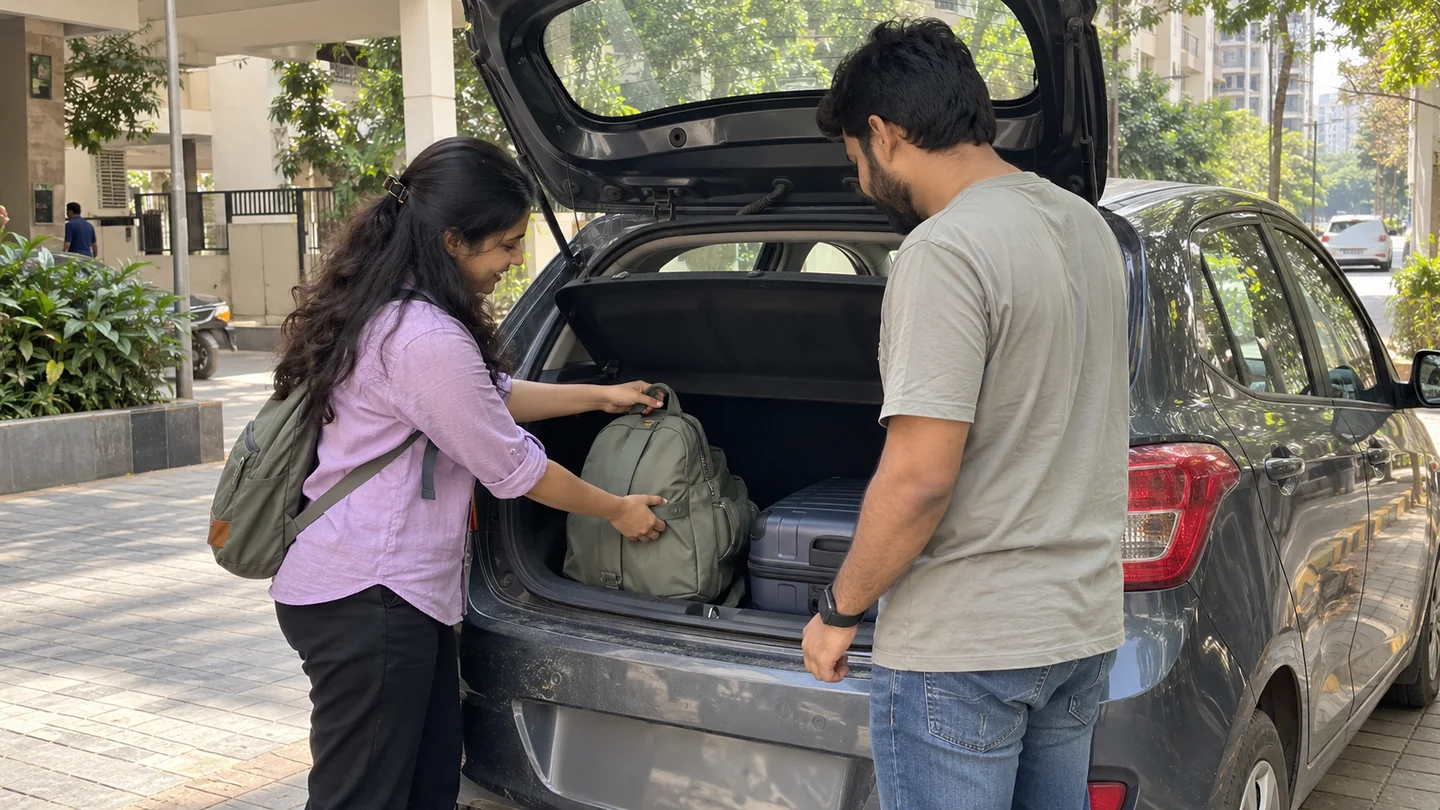
“One passenger” does not mean “one passenger with any amount of luggage”. A driver may have their own bags. Other riders may already use the boot. A large suitcase on a passenger seat can remove the seat you thought was available. An unusual item can block visibility or interfere with comfortable, belted seating.
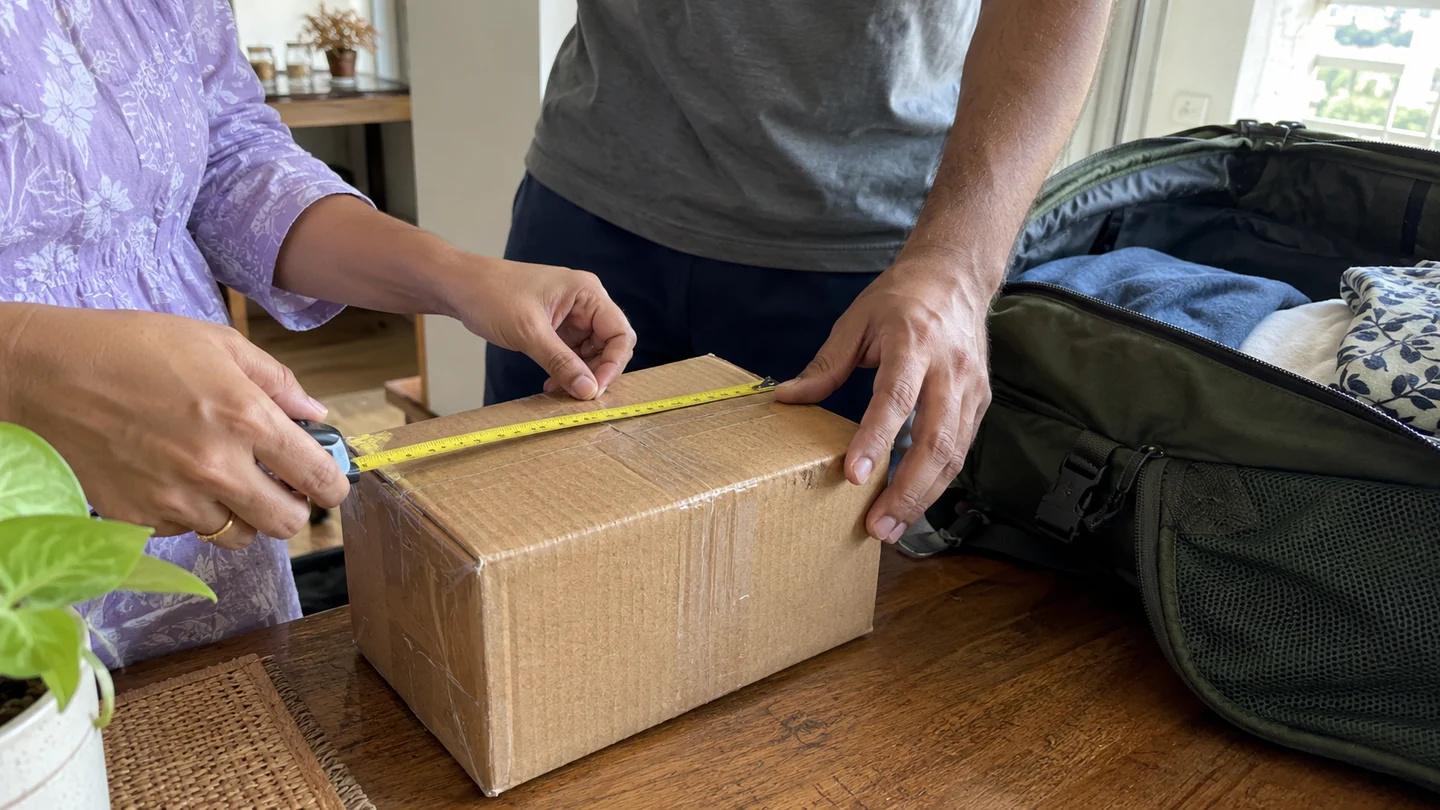
Send the luggage facts before confirmation. Count every item and describe the largest one. For a guitar case, folded wheelchair, sports kit, large carton or pet carrier, share dimensions and a current photo. Use the actual vehicle and the driver’s confirmed usable space. Do not rely on a generic boot-capacity number from another model year.
My preferred answer is not “it should fit”. It is one of three states: FITS, REVISE or DECLINE. FITS means the driver has confirmed the people and listed luggage can be carried without displacing an agreed passenger. REVISE means reduce bags, change the vehicle or change the arrangement. DECLINE means this journey is not a compatible match.
| Agreement field | Write the exact answer | Reconfirm when |
|---|---|---|
| People | Driver plus ___ passengers | Any person is added or removed |
| Small bags | ___ backpacks or cabin bags | Count changes |
| Large bags | ___ suitcases, each about ___ cm | Size or count changes |
| Unusual items | Item, dimensions, weight and photo shared | Packaging or dimensions change |
| Where luggage goes | Boot, footwell or another agreed safe space | Vehicle or seating plan changes |
| Final state | FITS, REVISE or DECLINE | Any detail above changes |
Score the ride before you press confirm
Give each essential line a simple status. Green means confirmed by both sides. Amber means the answer is incomplete and the ride should wait. Red means the plan is incompatible or the expected person, vehicle or arrangement does not match.
This works better than a decorative five-star feeling. A well-rated profile does not tell you whether your suitcase fits. A low-looking contribution does not tell you how you will reach a highway pickup. Identity verification can help establish identity, but it does not guarantee conduct, driving, timing or luggage space.
Use the safety and handoff guide for the checks around identity, meeting points and sensitive information. Keep login and identity-verification OTPs private. Share the agreed itinerary with a trusted person and meet at a clear, accessible place.
| Check | Green | Amber | Red |
|---|---|---|---|
| Pickup and drop | Exact pins accepted | Only an area or landmark | Unsafe, inaccessible or changed without agreement |
| Time | Window and buffer accepted | Approximate time only | Timing conflicts with a fixed connection |
| People and luggage | Count and space confirmed | Bag details missing | Items or passengers cannot fit |
| Complete cost | All four legs known | One leg unpriced | Fallback is unaffordable or unavailable |
| Match | Expected person, vehicle and plan | Detail still being clarified | Identity, vehicle or arrangement does not match |
 ShipdeHop
A no-invented-price comparison example
Suppose a traveller needs to go from a home in Bengaluru to a specific address in Mysuru. Option A is a regular shared ride with a meeting point. Option B is a door-to-door request that a flexible driver may accept. This is a method example, not a claim that either option is available on a particular date.
For Option A, enter the real cost and time from home to the meeting point, the listed or agreed contribution, the shared-drive estimate, and the trip from the drop point to the final address. For Option B, enter the accepted address-to-address plan and the contribution shown after the request is accepted. Keep any waiting buffer and fallback visible for both.
Now compare the totals. If Option B has a higher shared-ride contribution but removes two costly first and last legs, it may have the lower complete outlay. If Option A is cheaper overall and its meeting point is accessible, it may be the better fit. If the luggage state is amber or red, neither total is ready for a decision.
This is why I refuse to publish a fake universal winner. The provider name does not complete your journey. The accepted itinerary does.
| Worksheet line | Option A: meeting point | Option B: accepted door-to-door request |
|---|---|---|
| First-leg cost and time | ₹___ and ___ min | ₹___ and ___ min |
| Ride contribution | ₹___ | ₹___ |
| Shared-drive estimate | ___ min | ___ min |
| Last-leg cost and time | ₹___ and ___ min | ₹___ and ___ min |
| Waiting or pickup buffer | ___ min | ___ min |
| Luggage state | FITS / REVISE / DECLINE | FITS / REVISE / DECLINE |
| Complete outlay | ₹___ | ₹___ |
| Complete time | ___ min | ___ min |
| Fallback | Confirmed / missing | Confirmed / missing |
Reference BlaBlaCar India official Zen door-to-door carpooling page · Google Maps Help official trip-planning guidance
Copy this before confirming either ride
Send this: “Hi, I am travelling on [date] with [number] people. I will have [bag count and largest dimensions]. Please confirm the exact pickup pin and gate, pickup window, vehicle, usable luggage space, agreed contribution and exact drop pin. My first leg is [plan] and my last leg is [plan]. If either of us is delayed or the route changes, please message before departure. I will reconfirm if my passenger or luggage details change.”
For a BlaBlaCar Zen request, replace the pickup and drop lines with the chosen addresses and wait for the driver’s acceptance. BlaBlaCar says the driver keeps control of the route and decides whether the proposed detour suits them. For a regular meeting-point ride, keep the exact pin and last-mile plan visible.
For ShipdeHop, use the same discipline. A zero platform commission does not make every first mile, last mile or contribution free. Clear cost sharing is more useful than pretending the complete journey costs nothing.
Reference BlaBlaCar India official Zen door-to-door carpooling page
My practical verdict
Choose the option that produces the stronger accepted itinerary for this date, not the louder brand claim. BlaBlaCar currently documents a mature search and publishing flow plus optional Zen door-to-door requests. ShipdeHop offers an India-first zero-commission CarPool proposition and planning context, with current product and route availability checked before use. The CarPool route pages can help you start with a city pair, but they are not a seat guarantee.
If both options exist, compare the same cells. Exact pickup. Exact drop. Complete outlay. Complete time. Luggage state. Fallback. If one provider cannot give you the plan you need, the comparison is already over.
If neither shared ride fits, take a train, bus, taxi or another suitable option. Carpooling is valuable when an existing journey and a passenger’s need genuinely align. It becomes awkward the moment we force a mismatch and call it flexibility.
Reference BlaBlaCar India official carpool search · BlaBlaCar India official offer-seats and cost-sharing page
Compare the whole journey.
A cheaper seat can mean a longer, more expensive pickup. Put both options side by side.
Option B costs ₹90 less. Option B takes 65 fewer minutes.
Total = seat contribution + travel to pickup + travel after drop. Time = getting there + waiting + shared journey + getting to your destination. Add other known expenses to the relevant field. The starting amounts are editable examples.
Questions, answered
Is BlaBlaCar or ShipdeHop better for door-to-door carpooling?
There is no universal winner. BlaBlaCar currently describes optional Zen door-to-door requests where a flexible driver reviews and accepts the route. With ShipdeHop, do not assume door pickup. Compare the actual accepted pickup, drop, total cost, time, luggage and fallback for your date.
What should I compare besides the carpool contribution?
Add the cost and time from home to pickup, the shared ride, the last leg from drop-off and a practical fallback. Also confirm the passenger count, luggage, exact pins and meeting window.
Does ShipdeHop charge a CarPool commission?
ShipdeHop’s platform commission is zero, always. A driver and passenger may still agree a cost-sharing contribution, and the passenger may have separate first-mile or last-mile expenses.
Does BlaBlaCar Zen mean every ride is door to door?
No. BlaBlaCar describes Zen as optional. Drivers enable flexibility, review requests and decide whether a detour suits their route. Passengers can also use regular carpool meeting points.
How do I know whether my luggage will fit?
Send the item count, the largest dimensions and a current photo for unusual luggage. Ask the driver to confirm usable space in the actual vehicle. Reconfirm whenever the people, bags, vehicle or packaging changes.
Can a planning page guarantee a live carpool seat?
No. A planning page can help organise the decision, but route inventory, driver acceptance and the final arrangement must be checked in the current product flow.
Sources and useful references
External source pages checked on 23 October 2026. The worked amounts are inputs for the decisions explained above.
- BlaBlaCar India official carpool searchChecked 23 October 2026
- BlaBlaCar India official Zen door-to-door carpooling pageChecked 23 October 2026
- BlaBlaCar India official offer-seats and cost-sharing pageChecked 23 October 2026
- Google Maps Help official trip-planning guidanceChecked 23 October 2026

I’m building ShipdeHop around useful connections between people, journeys and pre-loved things. Zero commission. Now and always.
Why I’m building ShipdeHop →