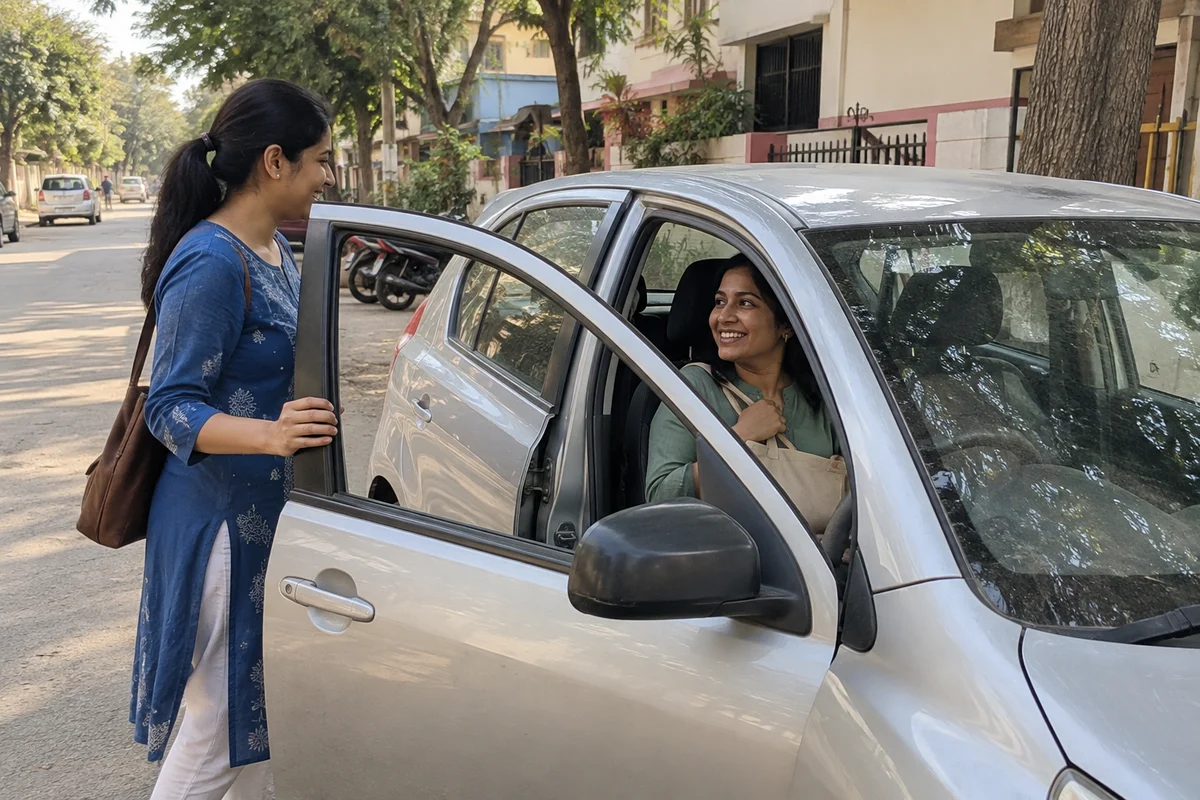
Before booking a carpool seat, add the cost and time of reaching the pickup, the agreed ride contribution and getting home from the drop-off. Confirm the landmarks, time window, luggage and fallback in writing. The lowest seat contribution does not always produce the lowest-cost or quickest journey.
A ₹350 carpool seat that starts 14 km away is not automatically cheaper than a ₹480 seat close to home. You still need to reach the first car. You still need to get back from the final drop. And you may be spending your Sunday morning at a junction watching three different white cars slow down.
I want ShipdeHop to help people share journeys that are already happening. That means the right question is not 'What is the cheapest seat?' It is 'What will the whole door-to-door journey cost me, in rupees and in time?'
Here is the pickup point worksheet I would use before agreeing to any seat. All rupee figures and journey timings below are invented examples to show the calculation, not live route quotes or promises of availability.
Price the journey from your actual door, not the driver's starting point
Carpool search commonly starts with a city or place, a destination, and a date. BlaBlaCar's official India site uses exactly that approach and says drivers publish a departure point, arrival point, time and seat contribution. That gives you a starting option, not a door-to-door itinerary.
Before saying yes, write down your starting address area and actual destination area. Then identify the exact meeting point and exact drop point. The last 5 km can matter more than the 500 km in the middle if your arrival is at night or you need to take a costly taxi.
Separate the shared seat cost from feeder and onward travel. Where pickup or drop points are far from home, consider whether a bus, metro, family drop, walking route or other service is practical. Check the real schedule before treating public transport as available. If you do not know the cost yet, label it 'unconfirmed' rather than adding ₹0.
Keep carpool and taxi propositions distinct. Quick Ride's official website has separate Carpool and Taxi categories, and its taxi search asks for pickup, drop and time. A commercial taxi pickup is not automatically included with a traveller's existing-route cost share.
Reference BlaBlaCar India official carpool search, ride sharing and help · Quick Ride official service descriptions separating carpool and taxi
My eight-cell door-to-door worksheet
Open a note before comparing two rides. I use four money entries and four time entries for each option. The money side is feeder travel, seat contribution, onward travel and an optional contingency. The time side is feeder duration, pickup buffer, time in the shared ride and last-mile duration.
If you are taking a bus to meet the driver, count the time spent waiting for that bus. If the meeting point is a petrol station on a highway, check safe pedestrian access rather than imagining you can just walk across six lanes. Your calculator should help you reject an impractical option, not merely decorate it with a cheap-looking total.
This ledger measures direct financial outlay and door-to-door time. It does not attach an invented monetary value to personal safety, comfort or reliability. Those can be separate reasons to choose another ride.
| Write this down | Money or time | Key question |
|---|---|---|
| Travel to pickup | ₹___ | How will I actually reach it? |
| Seat cost share | ₹___ | What contribution was agreed? |
| Travel after drop | ₹___ | How do I get home? |
| Contingency budget | ₹___ | What backup can I afford? |
| Time to pickup | ___ minutes | Including waiting for feeder transport? |
| Pickup buffer | ___ minutes | How early must I arrive? |
| Time in shared car | ___ minutes | What duration was discussed? |
| Time after drop | ___ minutes | Is onward transport available? |
 ShipdeHop
One trip, two pickup points, two very different totals
Imagine you need to travel from Bengaluru to Mysuru. Option A shows an illustrative ₹350 contribution. It starts at an inconvenient outer pickup point, requiring ₹180 to reach, and ends where you need ₹120 more to reach home. Total direct outlay is ₹650. With 50 minutes of feeder travel, a 25-minute pickup buffer, 180 minutes on the road and 35 minutes onward, the full plan takes 290 minutes, or 4 hours 50 minutes.
Option B has a higher seat contribution of ₹480 but a closer pickup and a more useful drop. You spend ₹45 to reach the meeting point and ₹35 after arrival. Direct outlay is ₹560. If the corresponding time figures are 15, 15, 180 and 15 minutes, the whole journey takes 225 minutes, or 3 hours 45 minutes.
Option B is ₹90 cheaper from door to door and 65 minutes shorter, even though its seat alone is ₹130 more. It is a deliberately simplified teaching scenario. A real search may show neither route, and the same travel time should not be assumed when routes differ. You must replace each figure with current, verified local options.
Notice how the driver's advertised seat contribution alone points the wrong way. The pickup point is part of the price. So is the drop point. If you compare rides without these, you are not comparing journeys.
| Illustrative measure | Option A | Option B |
|---|---|---|
| Seat contribution | ₹350 | ₹480 |
| Travel to pickup | ₹180 | ₹45 |
| Travel after drop | ₹120 | ₹35 |
| Total direct spending | ₹650 | ₹560 |
| Feeder plus pickup buffer | 75 min | 30 min |
| Shared car travel | 180 min | 180 min |
| Onward travel | 35 min | 15 min |
| Complete door-to-door duration | 290 min | 225 min |
Reference BlaBlaCar India official carpool search, ride sharing and help
My pickup point checklist before I agree
A 'near the flyover' pickup is not an address. A famous mall may have multiple gates. For an intercity ride, these ambiguities create missed departures and needless roadside detours. I would ask for the exact entrance or public landmark, a safe waiting area and a realistic meeting window.
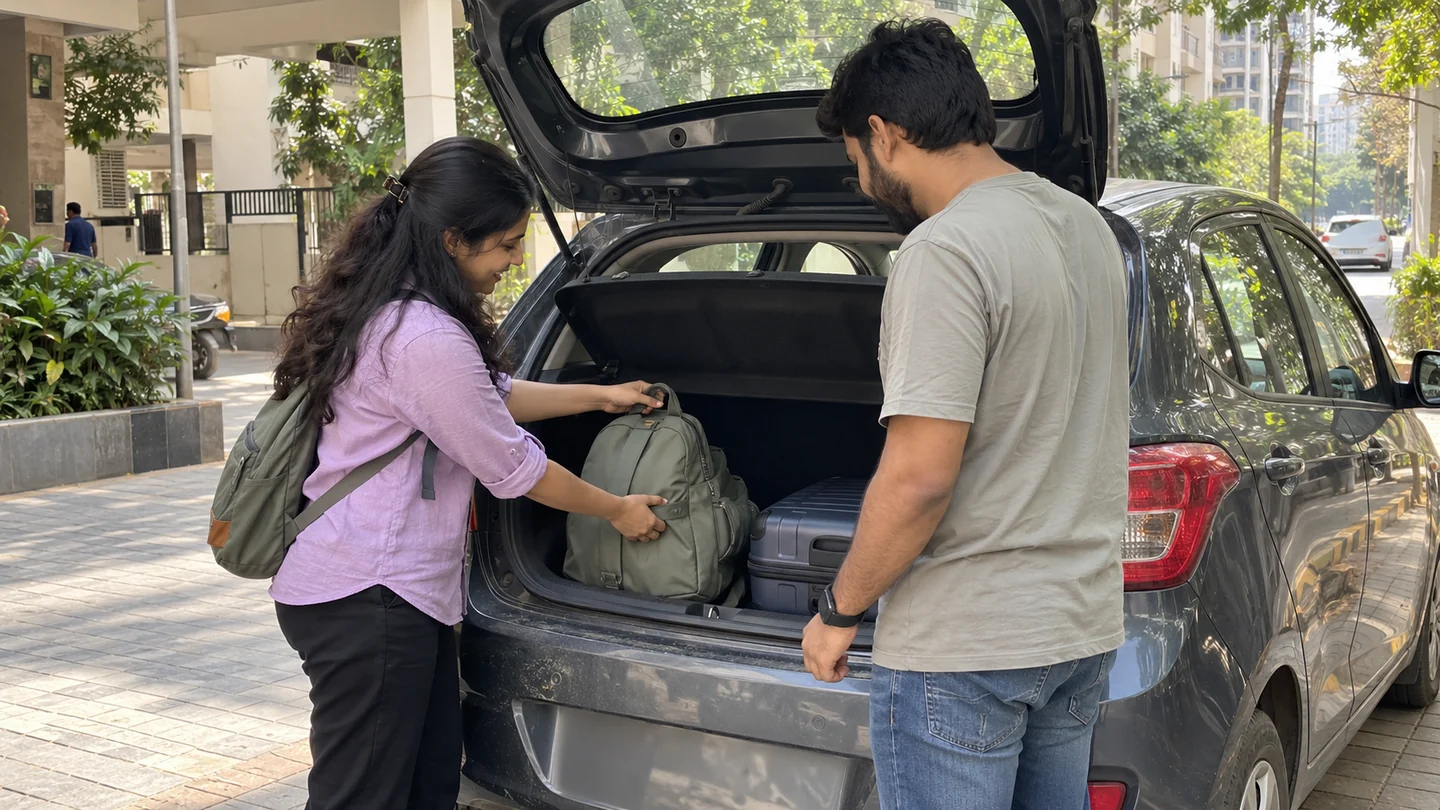
Make sure the driver and passenger have agreed on how luggage fits. A backpack and a large suitcase are not the same request. Tell the driver how many people are actually travelling. Do not assume extra passengers can turn up with additional bags.
I also want to know whether the journey already exists and whether the pickup is on the driver's intended route. Cost sharing around an existing trip is not the same proposition as hiring an on-demand taxi. If a very large detour is necessary, it may be the wrong match. A clear 'this one doesn't fit' is better than a stressful negotiation halfway there.
Driver and passenger should independently verify they have the expected person, vehicle and arrangement before getting in. Meet at an accessible, public location. Share trip details with a trusted person, keep your phone charged and do not disclose OTPs or sensitive identity documents to a stranger. Identity verification, where offered, is not a guarantee of conduct.
- Exact pickup pin and an identifiable gate or landmark
- Agreed pickup window, buffer and message-before-departure rule
- Safe access for pedestrians and actual public transport options
- Seat contribution and when payment is made
- Luggage, number of passengers and available space
- Exact drop pin and practical onward travel plan
- Cancellation, lateness and fallback expectations
What is an hour of inconvenience worth to you?
I would not pretend everybody values time the same way. For a student, an extra hour might be acceptable to save ₹100. For somebody who will miss a train connection, that hour may be unacceptable at any price. The question belongs to the traveller, not to a marketing claim.
When two options have different total costs and total durations, first look for one that is both cheaper and quicker. In the example, Option B wins on both numbers. If one is cheaper but slower, calculate the price of the time difference. Suppose one plan saves ₹120 but takes 90 minutes longer. The tradeoff is ₹80 saved per extra hour. Decide whether that is worth it for this particular day.
This 'rupees per extra hour' test is useful only if timings and access costs are credible. It does not replace safety checks or guarantee punctuality. Unexpected traffic, weather and delays can change an actual trip.
I would never pressure a user to choose a remote pickup purely to make a listing look inexpensive. The cost of reaching the seat belongs in the conversation before the booking.
Why I check pickup details instead of trusting a headline fare
Carpool providers themselves place importance on trip details. BlaBlaCar tells drivers to specify start, destination, departure date and time, seats and a price per seat. Its help section also says ride costs vary with distance, departure time and demand. The price displayed against a general city pair is not enough to determine my exact household-to-household cost.
Quick Ride describes a different mix of city mobility services, including taxi and carpool. This illustrates why I check whether an offer is cost sharing or a dedicated paid ride. The expected pickup responsibilities may be different. Read the actual offer and provider terms rather than transferring assumptions from one service to the other.
On ShipdeHop, I would use the planning tools to enter the real first and last legs, then check the available ride details in the app. ShipdeHop's platform commission is always zero. That does not make a shared seat contribution, taxi to pickup or onward travel free.
Reference BlaBlaCar India official carpool search, ride sharing and help · Quick Ride official service descriptions separating carpool and taxi
What remains for the driver?
Change the amounts to match your proposed arrangement. Include every relevant expense.
Questions, answered
What should I confirm before meeting a carpool driver?
Confirm the exact public pickup location, time window, vehicle and driver details, cost share, luggage space, number of passengers, drop location, and what happens if either person is late.
Is the cheapest carpool seat always the cheapest trip?
No. Add the transport to reach pickup and the onward travel from drop-off. The lowest seat contribution can produce a higher door-to-door total.
How do I calculate the total travel time for a carpool?
Add the time to reach pickup, pickup waiting buffer, ride duration, and time from drop-off to your final destination. Use current route and timetable information rather than guessed availability.
Does ShipdeHop charge passengers a commission?
ShipdeHop takes zero platform commission, always. The seat cost-share contribution and a passenger's own first-mile and last-mile transport are separate.
What if the pickup is at a highway junction?
Check for a safe, legal, accessible waiting area and a practical way to reach it. If access depends on unsafe crossing, uncertain transport or an unclear landmark, choose another meeting place or option.
Should I share OTPs or Aadhaar details with a carpool driver?
No. Do not share sign-in or identity-verification OTPs. Use the platform's own verification process where available, and remember that identity verification does not guarantee behaviour.
Sources and useful references
External source pages checked on 18 October 2026. The worked amounts are inputs for the decisions explained above.
- BlaBlaCar India official carpool search, ride sharing and helpChecked 18 October 2026
- Quick Ride official service descriptions separating carpool and taxiChecked 18 October 2026

I’m building ShipdeHop around useful connections between people, journeys and pre-loved things. Zero commission. Now and always.
Why I’m building ShipdeHop →