
Choose an intercity carpool when an existing journey fits your route, timing, passenger count and bags. Consider an outstation taxi when your group needs a specific pickup, agreed stops or more control over the trip. Compare the group’s complete door-to-door cost, not one carpool seat against a whole taxi, and confirm every inclusion before committing.
I would not compare one carpool seat with an entire taxi and announce a winner. That is like comparing one plate of lunch with the restaurant bill. First decide who is travelling, then price the same job.
This guide is for a solo traveller or small group choosing road travel between Indian cities. You may be visiting family, attending a wedding or travelling for work. The useful question is whether somebody else’s existing journey fits your plans, or whether you need a separately arranged vehicle journey.
My starting point is simple: a low total only matters after the trip meets your needs. An awkward pickup, unsuitable seat or unagreed extra stop can rule out an option before the calculator opens.
Carpool versus outstation taxi: what are you actually arranging?
An intercity carpool means joining a journey the driver already intends to make. A dedicated outstation taxi means arranging a hired-vehicle trip with a provider or driver. Hiring a taxi together with friends is shared spending, but it does not turn that taxi into a private existing-trip carpool.
BlaBlaCar’s India terms, reopened on 8 November 2026, describe private cost sharing rather than commercial hire for profit. Its India-specific booking section describes a contribution per seat. Uber’s India Intercity page instead presents an outstation-cab request using pickup and drop-off locations. These are examples of different arrangements, not evidence that either has a suitable car for your date.
Keep the distinction when using ShipdeHop CarPool. It is cost sharing around an existing journey, not a promise of on-demand taxi work. If your plan requires the driver to create a new route around your itinerary, ask whether you are really looking for a taxi instead.
Reference BlaBlaCar India terms: private cost sharing and per-seat contribution, checked 8 November 2026 · Uber India Intercity: outstation cab pickup and drop-off proposition, checked 8 November 2026
Use this decision table before looking for the lowest price
The table describes what to check, not a universal service guarantee. Read the actual offer and applicable terms. A carpool participant might agree a convenient pickup, and a taxi driver might decline an itinerary. Neither should be assumed.
The official sources beside this comparison are BlaBlaCar’s India terms for existing-trip cost sharing and Uber’s India Intercity page for the pickup/drop cab proposition. The recommendations about your group, bags and deadlines are my planning framework.
| Decision | Existing-trip carpool | Dedicated outstation taxi |
|---|---|---|
| What starts the journey? | A driver’s existing route and departure plan | Your requested trip, subject to provider acceptance |
| What price unit must you confirm? | Contribution per seat and any applicable platform charges | Whole-vehicle or other quoted unit, plus confirmed exclusions |
| Can the whole group fit? | Verify enough agreed seats in the same ride | Verify permitted passenger capacity for the selected vehicle |
| Where will you meet? | Agree pickup and drop on a compatible route | Request exact addresses and confirm access |
| Can you add stops? | Do not assume detours or waiting are included | Get the stops and waiting terms accepted |
| Will the bags fit? | Confirm space after the driver’s and other riders’ bags | Confirm actual vehicle luggage space, not just vehicle category |
| What if timing changes? | Check the participant’s cancellation and delay arrangement | Check the provider’s change and cancellation terms |
| When does it stop being suitable? | Your needs no longer fit the existing trip | The accepted itinerary, vehicle or complete quote does not fit |
Reference BlaBlaCar India terms: private cost sharing and per-seat contribution, checked 8 November 2026 · Uber India Intercity: outstation cab pickup and drop-off proposition, checked 8 November 2026
Normalize the quote: one seat is not the whole group
Write the passenger count at the top of the comparison. Then keep two totals: what the whole group will spend and what each person has agreed to pay. Do not switch between those totals halfway through.
For the carpool, add the confirmed contributions for every passenger, any applicable booking charges, the group’s travel to pickup and its onward travel after drop-off. If all passengers have the same contribution, multiplying by the passenger count is fine. Otherwise add the actual amounts individually.
For the taxi, start with the verified price unit. If the quote is for the whole vehicle, count that amount once. Add only charges confirmed as excluded, plus any necessary connections before or after the hired trip. Ask about tolls, state taxes, parking, waiting, extra kilometres, driver allowances and return-distance conditions. Those are questions to resolve, not charges every operator necessarily imposes.
Uber’s applicable-city Rentals and Intercity SaaS addendum, last modified 29 July 2026 and checked on 8 November, distinguishes suggested and agreed fares and lists possible additional charges including tolls, state taxes and parking. That is a reason to read the terms for your request, not to assume a single billing rule applies across all taxi services.
Unknown is not zero. Leave an unresolved item marked unconfirmed. Also do not add tolls twice when a quote already includes them. Keep an optional backup budget separate from the expected trip total so you do not present contingency money as a certain expense.
| Same-trip cost card | Carpool group total | Taxi group total |
|---|---|---|
| Main journey | Sum of all agreed seat contributions | Confirmed charge for the quoted unit |
| Platform or booking charge | Add if applicable and not included | Add if applicable and not included |
| Pickup and onward connections | Actual cost for the group | Actual cost for the group, if needed |
| Trip extras | Only agreed exclusions | Only confirmed exclusions |
| Expected group spending | Sum the confirmed items once | Sum the confirmed items once |
| Per-person spending | Use the group’s agreed allocation | Divide only as the actual group agrees |
| Still unresolved | List each unknown separately | List each unknown separately |
A three-person trip changes the comparison
Consider three friends planning one intercity journey. This is a decision example, not a reported trip or a fare estimate. All three need to reach the same address, and each has an overnight bag.
First, a carpool result needs three genuinely available, agreed seats in the same vehicle if the friends want to travel together. Three separate attractive listings do not meet that requirement. Next, all three bags need to fit with everyone else’s belongings. Until those questions are answered, there is no usable group option to price.
Now obtain a taxi quote for the exact date, pickup, drop and passenger count. Ask whether the quote covers the entire vehicle and all three people. Do not divide it by the maximum advertised capacity to make the personal price look smaller. Divide by the people actually travelling, and only after agreeing how the bill is shared.
The decision can change if one friend cancels. A fixed whole-vehicle bill may then be shared by two people rather than three. A carpool cancellation has its own terms, so do not assume the missing person’s contribution is automatically refundable. Recalculate both options before someone else quietly inherits the difference.
The taxi is not automatically cheaper for a group, and the carpool is not automatically cheaper for one person. The useful result is a confirmed group total attached to a journey that works. Replace every blank in the card with a current quote, not a remembered festival fare.
Seat count is not a complete comfort or luggage plan
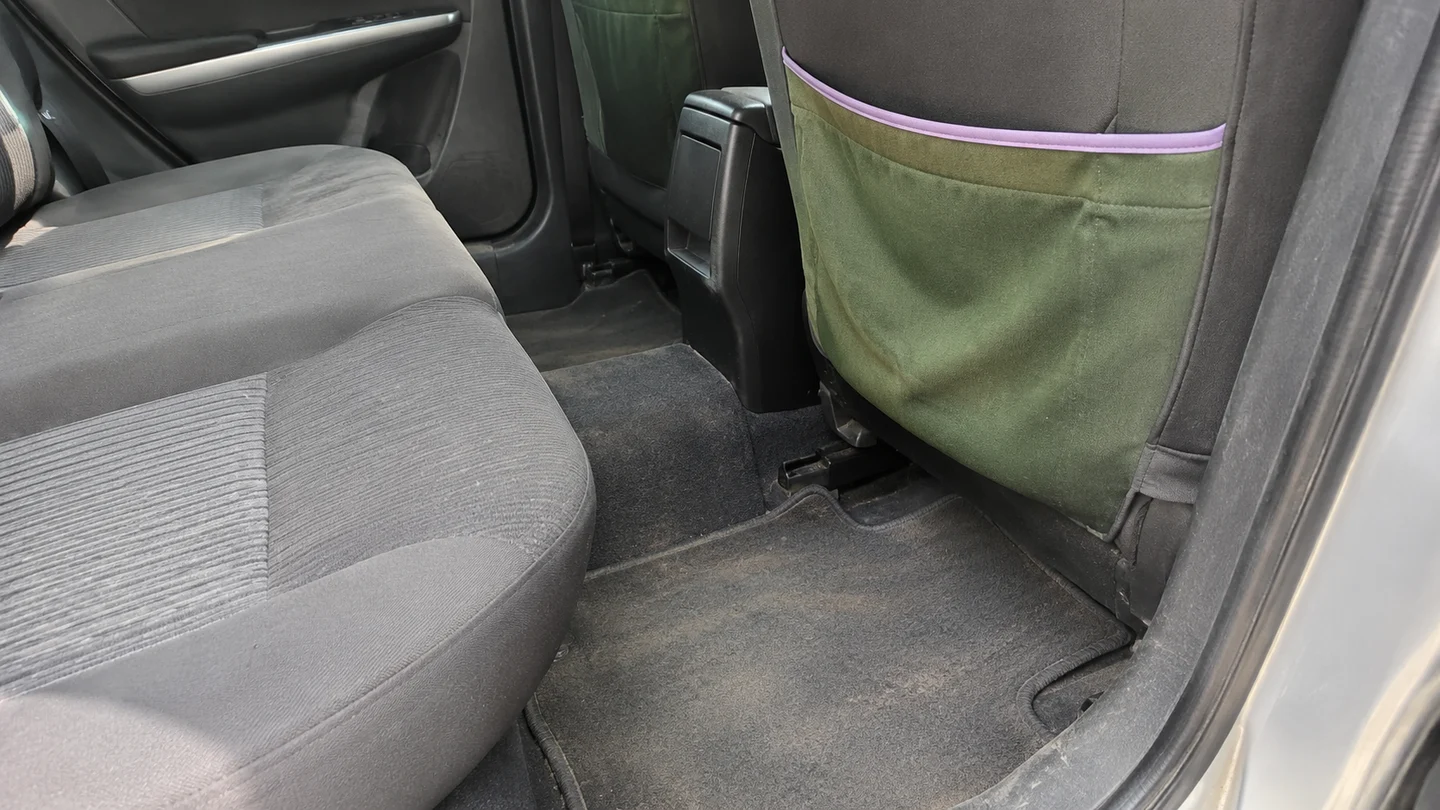
A vehicle can have an available seat without being a comfortable fit for every adult on a long journey. Ask about the actual seating arrangement, legroom and luggage space. A middle rear position can feel different from the seat shown in a listing photograph.
If someone finds getting into a low car difficult, explain that need before agreeing. Check the doorway, step-in height and space in the particular vehicle. A larger vehicle category is not proof of accessible transport. If the person needs specific assistance or equipment, seek a provider that can confirm those requirements.
Keep passenger space and bag space separate. Bags must not displace an agreed passenger or obstruct the use of a seat belt. Share the packed bag count and approximate dimensions, not just the phrase small luggage.
The carpool luggage agreement guide helps turn that conversation into a concrete check. Use the same discipline with a taxi. An accepted passenger count does not answer where three overnight bags will go.
Compare control and arrival time, not only road time
Write the earliest practical door departure and the latest acceptable arrival. Include reaching the pickup, waiting, the intercity leg, agreed stops and getting from the drop to your actual destination. Compare those complete timelines, not two map estimates with different endpoints.
A carpool is a stronger candidate when you can adapt to an existing departure and a sensible meeting point. A taxi is worth checking when the group needs one address pickup, a particular stop or an itinerary that does not align with another traveller’s route. Ask for acceptance of those requirements before treating them as included.
I would reject either option if its arrival plan leaves no realistic buffer for an important event. A taxi request does not eliminate traffic or cancellation risk, and a friendly driver’s estimate is not a punctuality guarantee.
Use the passenger journey calculator to record door-to-door costs and time. Its role is to expose the tradeoff. It cannot confirm a seat, vehicle, route availability or future traffic.
Send one brief to get comparable answers
Copy this request and fill the blanks: We are [number] adults travelling on [date] from [pickup area and pin] to [actual destination]. We need to arrive by [time]. We have [packed bags and approximate sizes]. Required stops are [list or none]. Please confirm the exact pickup, seats, vehicle, total price unit, included charges, excluded charges and payment method. What happens if the journey changes or is cancelled?
For a carpool, add: Does this fit your already planned journey, and are all our seats and bags agreed? For a taxi, add: Does this quote cover the accepted itinerary and our entire group, and are any minimum-distance, waiting or return conditions applicable?
Keep the answer in writing through the appropriate provider channel. Do not turn a partially answered message into a confirmed arrangement. If a fare detail changes at pickup, pause and resolve it before travel rather than hoping the final bill will be kind.
Review the safety guidance before meeting. Check the expected person and vehicle, choose accessible public meeting arrangements and share trip details with someone you trust. Identity verification, including Aadhaar where used, does not guarantee behaviour or make a journey risk-free.
Where ShipdeHop fits, and what to do next
I want ShipdeHop to help people make better use of journeys already happening. That is why I would start with the fit test, then the group-cost card, then the choice. I would not try to squeeze a taxi-shaped job into a carpool-shaped plan.
ShipdeHop takes zero commission, now and always. Participants’ agreed cost shares and their own connecting transport are separate expenses. That commission policy is not a claim that ShipdeHop beats a taxi quote or that travel costs disappear.
The website’s plans are browser-local planning tools, not live matching, confirmed bookings or payments. The iPhone app is available, Android is coming soon, and production payments and escrow are disabled. Check current availability rather than reading this article as a promise of a ride.
If an existing journey fits, take your completed brief to CarPool. If it does not, compare a suitable outstation taxi or another transport option. The right outcome is a workable domestic India journey, even when the answer is not a carpool.
Compare the whole journey.
A cheaper seat can mean a longer, more expensive pickup. Put both options side by side.
Option B costs ₹90 less. Option B takes 65 fewer minutes.
Total = seat contribution + travel to pickup + travel after drop. Time = getting there + waiting + shared journey + getting to your destination. Add other known expenses to the relevant field. The starting amounts are editable examples.
Questions, answered
Is a carpool cheaper than an outstation taxi in India?
Not always. Compare all passengers’ seat contributions and connections against the taxi’s complete group quote. Confirm the same date, endpoints, bags and itinerary. There is no useful universal saving without those details.
Can three friends book a carpool together?
Only if the specific ride has enough agreed passenger places and luggage space for all three. Confirm they are in the same vehicle. Separate listings do not establish a group arrangement.
Are tolls included in an outstation taxi fare?
Do not assume either way. Read the current quote and applicable terms, and ask which tolls, taxes, parking or other charges are included. Add confirmed exclusions once, not twice.
Can I ask a carpool driver to wait or make extra stops?
Ask before agreeing, but do not assume it is part of a seat contribution. The existing journey must still fit. If waiting or a custom itinerary is essential, check a suitable hired-vehicle arrangement.
Should I divide a taxi fare by its full seating capacity?
No. For your own group-cost comparison, use the actual travellers and their agreed allocation. Unfilled seats do not pay part of the bill, and advertised capacity does not establish bag fit.
Does the ShipdeHop website confirm a carpool booking?
No. Web plans are browser-local planning tools, not live matching or bookings. ShipdeHop takes zero commission, but participants’ agreed contributions and connecting journeys remain separate costs.
Sources and useful references
External source pages checked on 8 November 2026. The worked amounts are inputs for the decisions explained above.
- BlaBlaCar India terms: private cost sharing and per-seat contribution, checked 8 November 2026Checked 8 November 2026
- Uber India Intercity: outstation cab pickup and drop-off proposition, checked 8 November 2026Checked 8 November 2026
- Uber India Rentals and Intercity SaaS addendum: applicable cities, agreed fares and additional charges, modified 29 July 2026Checked 8 November 2026

I’m building ShipdeHop around useful connections between people, journeys and pre-loved things. Zero commission. Now and always.
Why I’m building ShipdeHop →