
For a carpool with luggage, tell the driver how many packed bags you have, their outer dimensions and approximate weight. Confirm usable storage after the driver’s and other passengers’ luggage, with every passenger seat still available as agreed. Record the arrangement before committing, and check again if the vehicle, bags or passenger count changes. A spare seat is not automatically spare luggage space.
You have found a shared ride for the weekend. The departure time works, the pickup seems manageable and the contribution fits your budget. Then you look at the suitcase, the backpack and the long racket case leaning against the wall.
This is the moment to ask about luggage, not the moment when the car arrives. A seat answers where you sit. It does not answer where your things go.
I would rather have one specific conversation now than a luggage negotiation on the roadside. Here is a practical agreement for students, weekend travellers and people going home with more than a laptop. The official guidance linked below was checked on 2 November 2026.
There is no luggage allowance you can borrow from another service
Do not treat an airline cabin-bag label or the word sedan as a carpool allowance. The actual vehicle, its configuration, the people travelling and their bags decide whether your arrangement works. The useful question is not whether a suitcase is normal. It is whether this suitcase fits this trip.
OUCAB’s luggage policy, updated 29 March 2026, describes its own recommended vehicle-category guidance as practical rather than airline-style rules. It makes acceptance dependent on usable space and avoiding obstruction, and asks multi-bag travellers to disclose bag numbers. Those are OUCAB’s rules, not a published ShipdeHop baggage entitlement.
Maruti Suzuki’s official owner-manual directory separates guidance by vehicle model and, where shown, powertrain. That is a useful reminder to consult the correct vehicle’s instructions rather than infer storage arrangements from a generic category photograph. This guide does not certify a vehicle’s loading capacity.
Start your ShipdeHop CarPool plan with the journey, people and luggage together. CarPool is sharing costs on a journey already planned. Neither a route match nor a friendly yes to one passenger resolves the full luggage arrangement.
Reference OUCAB official luggage policy, updated 29 March 2026 · Maruti Suzuki official vehicle-specific owner-manual directory · ShipdeHop CarPool planner, commission and current app availability
Describe the bag after packing, not when it was empty
Count every separate item you will bring. One large suitcase plus a laptop bag plus a sports case is three items to discuss, even if only one of them rolls. Mention rigid shapes and anything that cannot be compressed or placed under other luggage.
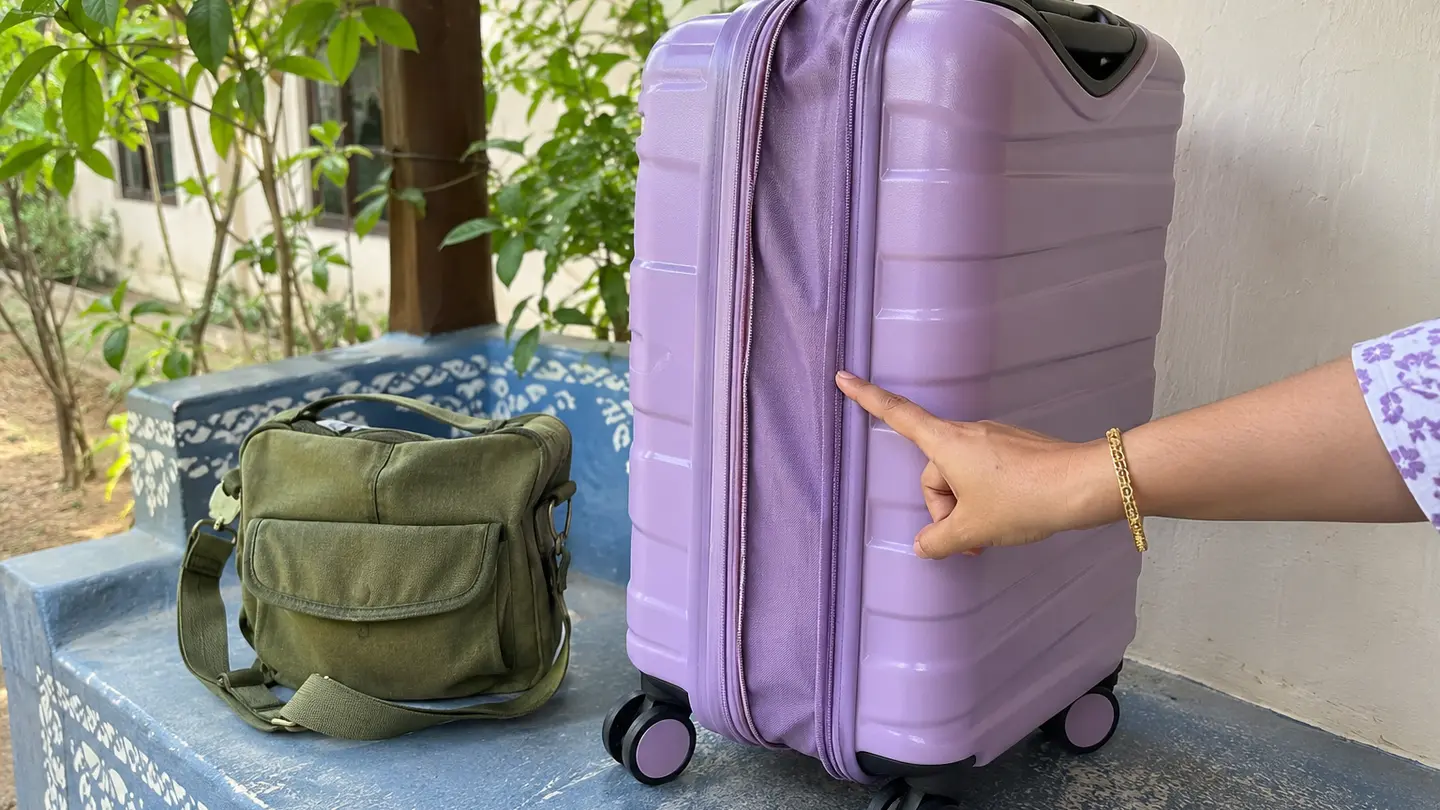
Give the outer length, width and height in cm, including wheels and handles. State whether the case’s expansion zip is open. Add approximate weight in kg if you can establish it, without guessing an exact figure. A photograph helps show the shape, but it does not replace measurements.
Do not describe an expanded hard case as a small bag because that was its size before packing. Equally, do not promise that a soft duffel will squash into any gap. What matters is how it can actually be placed without damage or interfering with people and the vehicle.
Keep personal addresses, baggage labels and documents out of photographs shared publicly. If you send a bag photo privately, crop or cover unnecessary identifying details. The driver needs the size and shape, not a picture of your passport.
Ask about the whole car, not just your corner of the boot
Ask whether the available luggage space accounts for the driver’s belongings and the bags of everyone joining later. A boot that looks empty before the first pickup can be a different proposition halfway through the route.
Confirm the actual vehicle and any storage constraints with the driver. If the answer is that it should somehow fit, the useful next question is what space is available with the agreed seats still usable. Do not solve the uncertainty by assuming another passenger will hold a suitcase.
OUCAB’s published guidance says bags should not block seats, exits, mirrors or the driver’s operation of the vehicle. Apply the practical lesson without importing its vehicle-specific bag counts: an arrangement needs to work without crowding passengers or obstructing the driver.
Do not improvise roof loading or seat-folding arrangements to make a doubtful plan appear workable. The driver should follow the actual vehicle’s instructions and applicable requirements. If you cannot establish an appropriate fit, choose a different journey or luggage plan.
| Situation | What to confirm | Decision before committing |
|---|---|---|
| One packed suitcase and small personal bag | Actual dimensions and shared storage after all travellers’ bags | Proceed only when a specific suitable placement is agreed |
| Expanded hard case or several bags | Every piece and the total usable storage, not a generic car category | Repack or find a more suitable ride if capacity remains uncertain |
| Long sports or instrument case | Length, shape and placement without taking an agreed passenger seat | Discuss separately rather than calling it a backpack |
| More passengers join or the car changes | The entire luggage arrangement in the changed vehicle | Reconfirm instead of relying on yesterday’s answer |
Reference OUCAB official luggage policy, updated 29 March 2026 · Maruti Suzuki official vehicle-specific owner-manual directory
The bag must reach the pickup point as well
A manageable suitcase at home may be awkward on the route to a pickup. Check stairs, walking surfaces, the distance you must carry it and how the first-mile connection handles the same luggage. Do the equivalent check after the shared ride ends.
For example, a student with a large case and a separate racket bag might prefer a pickup reachable without a long walk. That is a planning example, not a claim about any live ride. A nearby-looking point on a map is not proof that the approach works while carrying both items.
Ask where the car can stop appropriately and whether there is a reasonable opportunity to load. Avoid building a plan around hurried loading beside moving traffic. If you need help lifting a bag, discuss that need in advance rather than assuming another participant will provide it.
Use the complete journey calculator with your own first-mile, shared-ride and last-mile amounts and times. Include a more suitable connection if your bags require one. A cheaper seat can still produce a worse complete trip when the luggage makes both ends difficult.
Copy a luggage agreement that leaves fewer gaps
Keep the agreement in the relevant conversation rather than spreading essential details across a call, an old photo and somebody else’s message. You do not need a dramatic contract. You need the same practical picture in both people’s heads.
Try this message: I am travelling from [pickup] to [drop-off] on [date and time]. I have [number] bags. Their packed outer dimensions are [length × width × height in cm], and their approximate weights are [kg if known]. One item is [rigid, expanded or unusually shaped]. Is there suitable space after your luggage and everyone else’s, with all agreed passenger seats available?
Then add: Please confirm the actual vehicle, the loading point, any assistance we have agreed and the contribution for the journey. If the vehicle, passengers or luggage changes, let us check the plan again before pickup. My drop-off connection also needs to handle these bags.
The placeholders are for the conversation, not a demand to publish private travel information. Keep precise personal details within the appropriate channel. A screenshot of a general car listing is not the driver’s confirmation of your actual bags.
- Passenger confirms the complete bag list after packing.
- Driver checks the list against the actual shared load.
- Both agree pickup, drop-off and any lifting assistance.
- Both record the journey contribution and any agreed change.
- Both recheck when a material part of the plan changes.
A changed bag is a changed arrangement
If you add gifts, another shopping bag or sports equipment after the first conversation, send the updated list before travelling to the pickup. The same applies if another person joins you. Do not make the driver discover the difference beside the car.
Drivers should also communicate a different vehicle or a change that affects luggage capacity. Earlier agreement about space is not permission to squeeze the same load into a different arrangement. Passenger and driver both need a realistic opportunity to reconsider.
A bag travelling with you is also not the same decision as sending an unaccompanied item. BlaBlaCar’s terms, applicable from 15 June 2026, prohibit booking a seat for an object, package or animal travelling alone. That is a specific platform distinction, not a rule this article invents for every service.
If your actual need is sending something without travelling, explore ParcelPool and its contents, packaging and handoff requirements separately. Do not hide a delivery task inside a passenger luggage description. The person and the item should match the arrangement everyone accepted.
Reference BlaBlaCar official terms, version applicable from 15 June 2026
Choose a workable ride, not an argument you hope to win
Before departure, check the actual people, vehicle and packed bags against the agreement. Keep each passenger’s proper seating and seat-belt use intact. If the arrangement cannot be made appropriately, pause rather than turn loading into a contest of optimism.
Read the safety guidance before agreeing a shared journey. Aadhaar verification helps establish identity. It is not a luggage inspection or a guarantee of behaviour, driving or personal safety. Keep authentication codes and identity documents private.
ShipdeHop takes zero commission, now and always. That does not make the first-mile connection, last-mile connection or the journey itself free. CarPool contributions share travel costs rather than promise driver profit.
As checked on 2 November 2026, the website lists iPhone availability and Android as coming soon. Its browser planner keeps a local draft, not a reserved seat or confirmed storage allocation. Continue through the app for current options, and use the explicit-consent signup if you want updates.
My rule is simple: if the luggage only fits after you ignore another passenger, change the luggage plan or the ride. Your suitcase does not get to negotiate somebody else’s seat.
Reference ShipdeHop identity and practical safety guidance · ShipdeHop CarPool planner, commission and current app availability
Compare the whole journey.
A cheaper seat can mean a longer, more expensive pickup. Put both options side by side.
Option B costs ₹90 less. Option B takes 65 fewer minutes.
Total = seat contribution + travel to pickup + travel after drop. Time = getting there + waiting + shared journey + getting to your destination. Add other known expenses to the relevant field. The starting amounts are editable examples.
Questions, answered
How much luggage is allowed in a carpool in India?
Do not assume a universal allowance. Check the service’s current rules and confirm your packed bags with the driver for the actual vehicle and passenger load. Include dimensions, bag count, approximate weight and unusual shapes. A spare passenger seat does not automatically establish luggage capacity.
Does a cabin-size suitcase automatically fit a shared ride?
No. The label does not account for the actual storage space or other travellers’ luggage. Describe the packed outer dimensions, including wheels and handles, and confirm where it can be placed without displacing an agreed passenger or creating an obstruction.
What if I add another bag after agreeing the ride?
Tell the driver before going to the pickup and reconfirm the complete arrangement. If there is no suitable space, repack or choose another plan. Do not assume the earlier agreement covers extra pieces or an expanded suitcase.
Can I send a suitcase in a carpool without travelling?
Do not assume a passenger service permits that. Check the specific platform’s rules. For ShipdeHop, investigate the separate ParcelPool service and its item and handoff requirements rather than describing an unaccompanied item as passenger luggage.
Should I include luggage in my journey budget?
Include any first-mile or last-mile travel and handling arrangements your luggage actually requires. Use your own quotes and timings. The complete journey calculator helps compare those amounts, but does not establish vehicle fit or reserve a ride.
Sources and useful references
External source pages checked on 2 November 2026. The worked amounts are inputs for the decisions explained above.
- OUCAB official luggage policy, updated 29 March 2026Checked 2 November 2026
- Maruti Suzuki official vehicle-specific owner-manual directoryChecked 2 November 2026
- BlaBlaCar official terms, version applicable from 15 June 2026Checked 2 November 2026
- ShipdeHop CarPool planner, commission and current app availabilityChecked 2 November 2026
- ShipdeHop identity and practical safety guidanceChecked 2 November 2026

I’m building ShipdeHop around useful connections between people, journeys and pre-loved things. Zero commission. Now and always.
Why I’m building ShipdeHop →